
Restaurant owners often assume that part-time staffing creates less insurance complexity than full-time staffing. That assumption is common, especially in restaurants where schedules change weekly, shifts are split across lunch and dinner service, and labor is built around fluctuating demand. But workers’ compensation for part-time restaurant staff in Florida is one of the areas where restaurant owners can misread their obligations and their actual risk exposure. Florida’s workers’ compensation rules do not treat part-time restaurant employees as invisible simply because they work fewer hours, and the state specifically says that in non-construction industries, employers with four or more employees, full-time or part-time, generally must carry workers’ compensation coverage.
Why Part-Time Staffing Creates Real Coverage Questions
Restaurants rely heavily on part-time labor because the model often demands flexibility. Hosts, servers, bussers, dishwashers, prep workers, and support staff may rotate in and out of shifts based on seasonality, weekends, events, or daily volume. From an operational standpoint, that feels normal. From an insurance and compliance standpoint, it can create a blind spot. The Florida Department of Financial Services says workers’ compensation insurance is mandatory for most employers in the state, and its employer materials make clear that part-time workers count in the non-construction threshold calculation.
That matters because restaurant owners often think in hours worked, not in how Florida counts employees for coverage purposes. A business may view its staffing as “mostly part-time” and therefore assume it remains beneath the threshold or faces lower urgency. But the state’s rule is not built around whether those employees work forty hours. It is built around whether they are employees and whether the business has reached the applicable threshold. For restaurants, that makes Florida restaurant workers’ compensation for part-time employees a practical risk-management issue, not just a technical compliance detail.
Florida’s Basic Rule Is Simpler Than Many Owners Think
The core Florida rule for many restaurants is not especially vague. The Florida Division of Workers’ Compensation states that in the non-construction industry, employers with four or more employees, including part-time employees, generally must have workers’ compensation coverage. Employee-facing materials from the same state system make the same point: if an employer is in an industry other than construction and has four or more employees, full-time or part-time, workers’ compensation coverage is required.
Restaurants often miss this because the staffing model feels fluid. A restaurant may have two full-time kitchen workers, one part-time host, one part-time dishwasher, and one part-time server who only appears on busy nights. Operationally, the owner may not perceive that as a “larger” workforce. Legally and administratively, however, the part-time employees still matter.
The U.S. Small Business Administration also reinforces the broader point that businesses with employees can be legally required to carry workers’ compensation, and that state law determines the specific requirements. That framework is useful for restaurant operators because it underlines a simple principle: businesses should not assume that informal staffing or reduced hours erase formal insurance obligations.
Why Restaurants Are Especially Exposed Even With Part-Time Teams
Restaurants are not low-risk workplaces just because many positions are part-time. OSHA’s restaurant eTool describes restaurant work as a hazard-rich environment and notes that restaurants and other eating and drinking businesses employ millions of people, with a large share of workers being young or relatively inexperienced. The tool also identifies hazards such as burns and scalds, slips/trips/falls, strains and sprains, cuts, machine guarding issues, hazardous chemicals, and electrical hazards across different restaurant work areas.
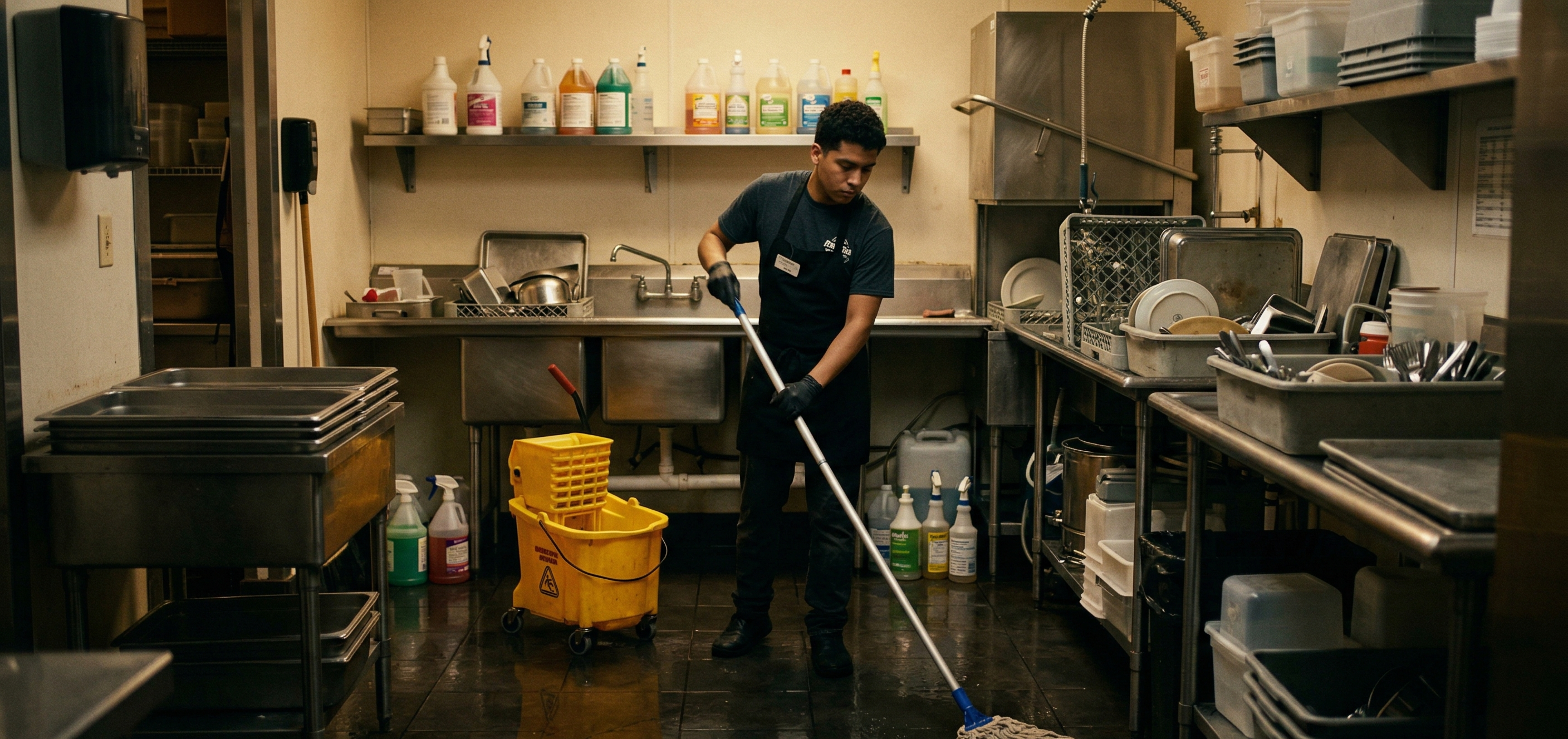
That matters because part-time employees are often the very employees most likely to be newer, less experienced, or assigned to fast-moving support tasks. A part-time dishwasher may still handle slippery cleanup conditions. A worker may still use sharp tools and work around equipment. A part-time server may still move quickly across wet floors carrying hot plates. A part-time fryer worker may still face burn exposure. In practical terms, reduced hours do not eliminate injury exposure. They simply reduce the number of hours during which injury might occur. The hazard itself remains. OSHA’s restaurant safety resources make clear that the risks are tied to the tasks and environment, not to whether the worker is full-time.
This is why workers’ compensation requirements for part-time restaurant workers should not be approached as if part-time status automatically means low consequence. In a restaurant, even a worker with a limited weekly schedule may still spend those hours in one of the highest-risk parts of the operation.
One of the Biggest Mistakes: Confusing Small Hours With Small Exposure
A common restaurant-owner assumption is that part-time employees represent lower exposure because they are “only there a little.” That can sound logical from a labor-cost perspective, but it does not necessarily hold from an injury or compliance perspective.
A worker does not need forty hours a week to slip on a wet floor, get burned by hot oil, strain a back while lifting supplies, or suffer a cut during prep. OSHA’s serving, food preparation, cooking, and cleanup guidance shows that these risks can arise during ordinary restaurant activity, including serving customers, handling kitchen equipment, cleaning, and moving through wet or cluttered spaces.
Florida’s coverage requirements likewise do not say that part-time workers are exempt from counting because they have fewer weekly hours. The state’s rule explicitly refers to full-time or part-time employees. For restaurants, that means the part-time staffing model may reduce payroll in one sense, while still preserving real injury exposure and real coverage obligations in another.
Why Threshold Confusion Happens So Often in Restaurants
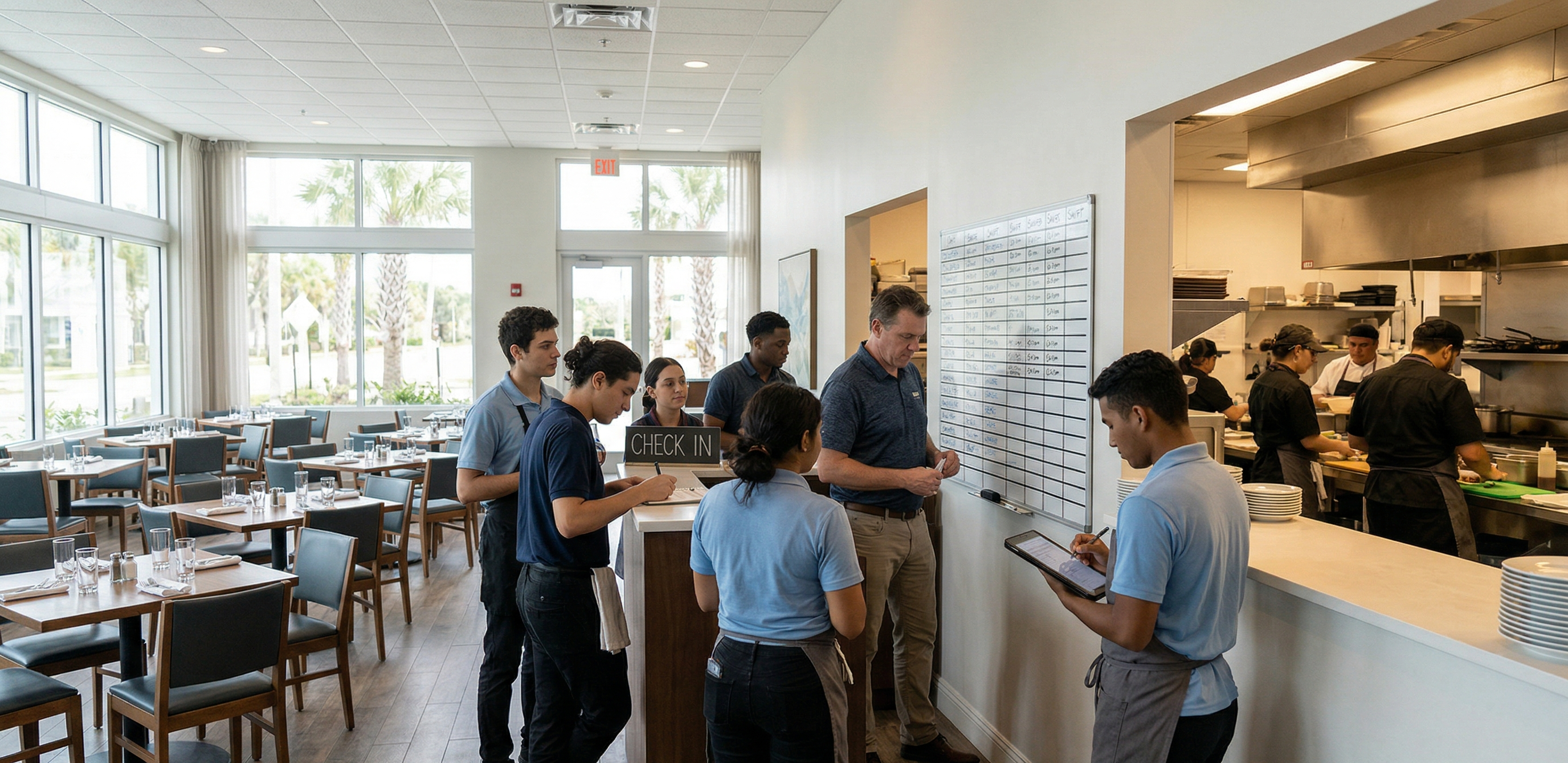
Restaurants are unusually prone to threshold confusion because staffing is often dynamic. Employees may come and go seasonally. Some workers appear only on weekends. Others rotate between short shifts and heavier schedules during holidays or special events. A restaurant owner may think of the workforce as “three people and some extra help,” while the state may see a non-construction employer with four or more employees.
Florida’s employer FAQ and coverage pages are useful here because they repeat the threshold plainly: a non-construction employer is required to obtain a Florida policy once it has four or more employees working in Florida. Employee-facing guidance also clarifies that part-time workers count in that determination.
That is especially relevant for restaurants with layered scheduling. The owner may not feel like the business has a “real staff” of four or more because no single day looks identical. But coverage rules are not written around a casual impression of labor structure. They are written around employee status and the applicable threshold.
Exemptions Are Often Misunderstood Too
Another major problem is exemption confusion. Some restaurant owners hear that business owners or LLC members may be exempt and then assume that exemptions apply broadly across the business. Florida’s exemption materials do not support that kind of broad assumption. The state explains that exemptions require a formal application process, and its exemption-eligibility presentation states that exemptions are issued to qualifying individual officers or members, not to the corporation or LLC as a whole.
That distinction matters a great deal in restaurants. An exempt qualifying owner is not the same thing as an exempt business. If a restaurant has staff members who are employees, the staffing threshold analysis still matters. Florida’s exemption pages for non-construction businesses also make clear that the system involves individual qualification and application, not an informal belief that “we are probably exempt.”
For that reason, part-time restaurant staff workers’ comp Florida should not be evaluated through hearsay, industry rumor, or assumptions carried over from another type of business. The exemption issue is narrower and more formal than many owners realize.
The Restaurant Environment Makes Inexperience More Important
Another point restaurant owners often miss is the relationship between part-time staffing and inexperience. OSHA’s restaurant eTool emphasizes that many young workers get their first job experience in restaurants, and it provides hazard-specific guidance for serving, food prep, cooking, and cleanup precisely because the industry combines fast pace with physical risk.
That observation is especially relevant to part-time labor. Restaurants often hire students, younger workers, and entry-level staff for part-time shifts. These workers may be less familiar with slippery floors, hot surfaces, machine guarding, chemical handling, and fast dining-room traffic. So even if a restaurant owner thinks of part-time staff as temporary or supplemental, the risk profile may actually be elevated in specific ways because of inexperience and task intensity.
This does not mean every part-time employee is more dangerous to insure. It means that part-time status should not be equated with trivial exposure. In restaurants, the combination of physical hazards and inexperienced staffing can make injury exposure more meaningful than owners first assume. OSHA’s detailed restaurant guidance strongly supports that operational point.
Why Workers’ Compensation Is Also a Lawsuit-Protection Issue
Some restaurant owners view workers’ compensation only as an employee-benefits question. That is incomplete. CIS’s own workers’ compensation page explains that workers’ compensation covers medical expenses, lost wages, and related costs for injured employees, and it also states that the coverage protects employers from lawsuits related to workplace injuries or illnesses.
That second point matters because a restaurant injury is not only a staffing inconvenience. It can become a legal and financial issue if the business does not have the right coverage structure in place. The SBA’s business insurance guidance also emphasizes that certain insurance is legally required for businesses with employees and that businesses should review state requirements for compliance.
For restaurant owners, this means workers’ compensation for part-time restaurant staff in Florida should be understood as part of both employee protection and business protection. It is not only about doing the right thing for workers after an injury. It is also about reducing the risk of much larger downstream consequences for the business.
What Part-Time Restaurant Jobs Still Commonly Expose the Business To
A useful way to think about this topic is to move away from the label “part-time” and focus on what the employee actually does.
A part-time server may still face slips, trips, falls, burns, cuts, strains, and even workplace violence concerns in front-of-house service. OSHA explicitly lists those hazards in the serving section of its restaurant eTool.
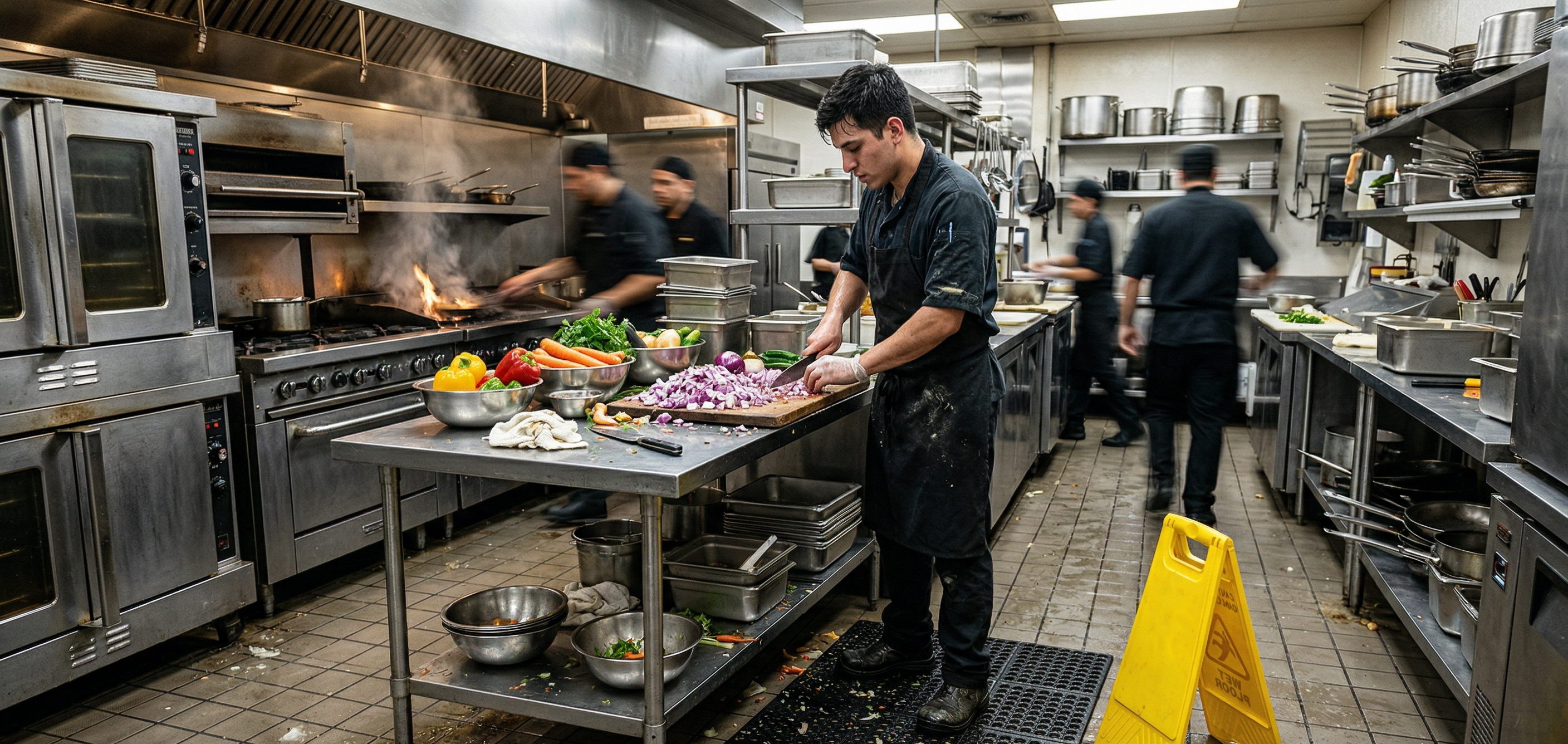
A part-time prep worker may still work around knives, machine guarding risks, slippery conditions, and repetitive strain in food preparation areas. OSHA identifies these hazards in its food preparation section.
A part-time cleanup worker may still face burns, cuts, hazardous chemicals, electrical hazards, slips/trips/falls, and strains and sprains. OSHA identifies all of those in the cleanup section.
A part-time cook or fryer worker may still face burn exposure, fall hazards, and strain-related conditions in cooking areas. OSHA’s cooking section highlights those risks directly.
When owners look at the tasks rather than the schedule, it becomes easier to see why Florida restaurant workers’ compensation for part-time employees deserves serious attention.
Practical Signs a Restaurant May Be Underestimating This Issue
There are several warning signs that a restaurant may be underestimating workers’ compensation for part-time restaurant staff in Florida.
The owner says, “Most of my people are only part-time.”
That phrase often signals threshold confusion. Florida’s non-construction rule counts part-time employees too.
The business has grown gradually without a formal coverage review.
Restaurants often add people incrementally. A host here, a dishwasher there, a weekend prep worker later. That kind of growth can move a business into mandatory coverage territory without the owner experiencing a dramatic “hiring moment.” Florida’s FAQ materials support checking actual employee count rather than relying on impression.
The owner believes the LLC or corporation is exempt.
Florida’s exemption materials show that exemptions apply to qualifying individuals, not automatically to the entity.
Part-time employees work in kitchens, cleanup, or prep.
OSHA’s restaurant guidance makes clear that these tasks still involve real injury hazards.
The business has many younger or newer employees.
OSHA’s restaurant eTool specifically notes the industry’s large share of young workers and its focus on helping inexperienced workers stay safe.

Why This Topic Fits a Broader Restaurant Risk-Management Review
CIS’s homepage positions the agency as focused on commercial insurance solutions with an emphasis on risk management, and that framing is especially relevant here. A restaurant that relies on part-time labor should not isolate workers’ compensation as a narrow administrative question. It should review it alongside broader realities:
- staffing structure,
- actual job duties,
- pace of operations,
- training,
- documentation,
- liability exposure,
- and the way the business is evolving.
CIS’s restaurant and entertainment insurance page also lists workers’ compensation as one of the core coverages relevant to restaurants, alongside property, liability, commercial auto, crime, cyber, and equipment breakdown coverage. That structure reflects the reality that restaurants are multi-risk businesses. The staffing model is part of that multi-risk picture, not a separate side issue.
What Restaurant Owners in Florida Often Miss About Part-Time Staff
If this topic can be reduced to one core insight, it is this: part-time status does not erase employee status, and lower weekly hours do not erase real injury exposure.
Florida’s workers’ compensation system treats part-time workers as relevant to the non-construction coverage threshold. OSHA’s restaurant safety materials show that restaurant work remains physically risky across serving, cooking, prep, and cleanup tasks. The SBA’s business insurance guidance reinforces that employee-related insurance obligations are legally important for businesses with staff. Put together, those sources tell a consistent story: restaurants should not assume that a part-time-heavy workforce means workers’ compensation can be treated casually.
That is especially true in restaurants where part-time labor is not peripheral. In many operations, it is the model itself. And if part-time labor is central to the business, then the workers’ compensation conversation is central too.
Final Thoughts
Workers’ compensation for part-time restaurant staff in Florida is often misunderstood because restaurant owners naturally think in terms of hours, shifts, and scheduling flexibility, while Florida’s coverage rules focus on employee count and industry category. The result is a recurring blind spot: owners may assume that “mostly part-time” means “probably not required,” even when the state’s own materials say otherwise for non-construction employers with four or more full-time or part-time employees.
For restaurants, that misunderstanding can be especially costly because part-time employees still work in environments where OSHA identifies burns, cuts, slips, strains, chemicals, and electrical hazards as real concerns. The better approach is to review the actual staffing structure, the job duties being performed, whether any exemptions truly apply, and how workers’ compensation fits into the broader restaurant insurance strategy. In an external editorial context, that is the natural point to connect readers with more restaurant-specific workers’ compensation and risk-management guidance.

 Dubb
Dubb

 USA.CIS