By Juan Jimenez, SprayAlliance Corp
You might be wondering “how much does a spray foam rig cost”. The answer depends entirely on what is included in the package and what kind of work the contractor plans to do with it. A basic entry-level setup can start around $15,000 to $25,000, while a fully equipped, professional-grade rig built for daily commercial and residential production typically falls between $40,000 and $60,000 or more. But the purchase price of the rig itself is only part of the picture. Training, insurance, material inventory, vehicle costs, and ongoing maintenance all add to the real number a contractor needs to have mapped out before taking on the first job.
SprayAlliance Corp specializes in building compact, professional-grade spray foam rigs designed for contractors who want to enter the industry or expand their operations without overextending on equipment costs. Operating from Stamford, CT, the company works with contractors across the NY / NJ / CT tri-state region and beyond, helping them match rig configurations to their target markets and budgets.
What Are the Main Components of a Spray Foam Rig and How Do They Affect the Total Price?
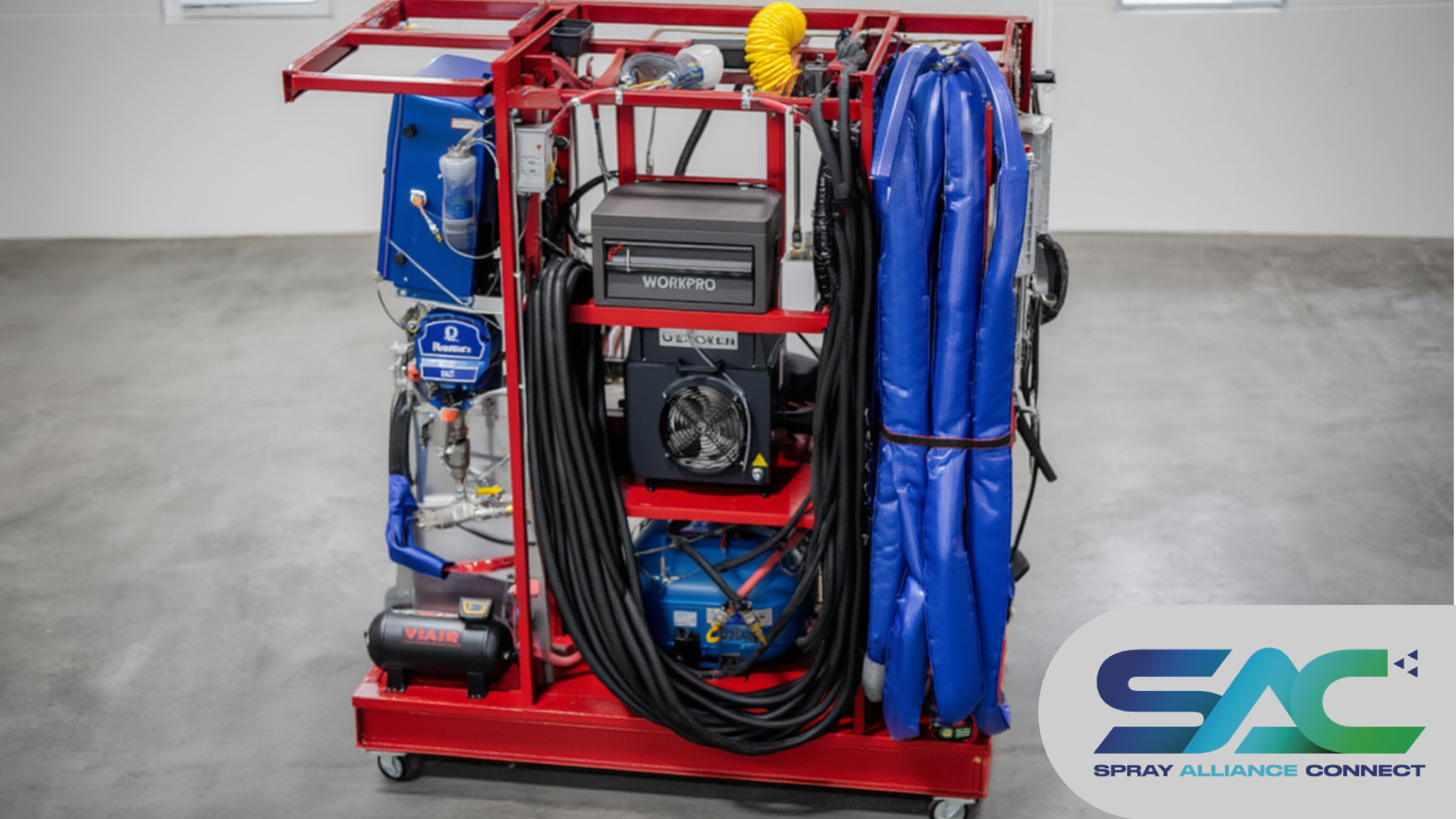
A spray foam rig is not a single piece of equipment. It is a system made up of several components that all need to work together. Understanding what each piece does and what it costs individually is the first step toward understanding why rig prices vary so much from one listing to the next.
The most expensive component is the proportioner, the machine that heats, pressurizes, and mixes the two liquid chemicals (commonly called the A-side and B-side) that react together to form spray foam. Entry-level proportioners, like the Graco E-20, are designed for smaller jobs and lower daily output. They typically cost between $8,000 and $15,000. Professional-grade proportioners, like the Graco Reactor 3, are built for high-volume daily production, offer better temperature control and yield efficiency, and typically range from $20,000 to $30,000. The proportioner a contractor chooses determines how many board feet of foam the rig can produce per day, which directly affects how many jobs can be completed and how much revenue the business generates.
Beyond the proportioner, a complete rig includes a compressor to power the spray gun, a generator to supply electricity on job sites without reliable power, heated hose sets that keep the chemicals at the right temperature from the machine to the gun, a spray gun, transfer pumps to move material from the drums into the proportioner, and the drums of chemical material themselves. Each of these components adds to the total cost. A set of heated hoses alone can run $3,000 to $6,000 depending on length. A commercial-grade compressor suitable for daily spray foam work typically costs $3,000 to $8,000. Generators capable of powering the full system range from $3,000 to $10,000 depending on output capacity.
This is why two rigs advertised at similar prices can be very different in actual capability. A $25,000 listing that includes an entry-level proportioner, short hoses, and no generator is a fundamentally different product than a $45,000 rig built around a Reactor 3 with long heated hoses, a commercial compressor, and transfer pumps included. Contractors evaluating a spray foam rig for sale need to look at the full component list, not just the headline price.
What is included in a spray foam rig?
A spray foam rig typically includes a proportioner to heat and mix chemicals, a compressor to power the spray gun, a generator for on-site electricity, heated hose sets, a spray gun, and transfer pumps. Some packages include chemical drums. The proportioner is the most expensive component and has the biggest impact on overall rig performance.
How Do Van Rigs, Trailer Rigs, and Compact Setups Compare in Cost and Capability?
The format of the rig, how it is housed and transported, affects both the upfront investment and the ongoing operating costs in ways that many new contractors do not anticipate.
Trailer rigs are the traditional setup. All the equipment is mounted inside an enclosed trailer, which is towed to the job site by a heavy-duty pickup truck. Trailers offer the most space for equipment and material storage, and they can support the largest proportioners and compressors. However, the total cost includes not just the rig and trailer but also the tow vehicle, which can add $40,000 to $70,000 to the investment if a suitable truck is not already owned. Fuel costs are higher, insurance is higher, and parking a large trailer on city job sites, especially in dense markets like the New York metro area, can limit the types of projects a contractor can access.
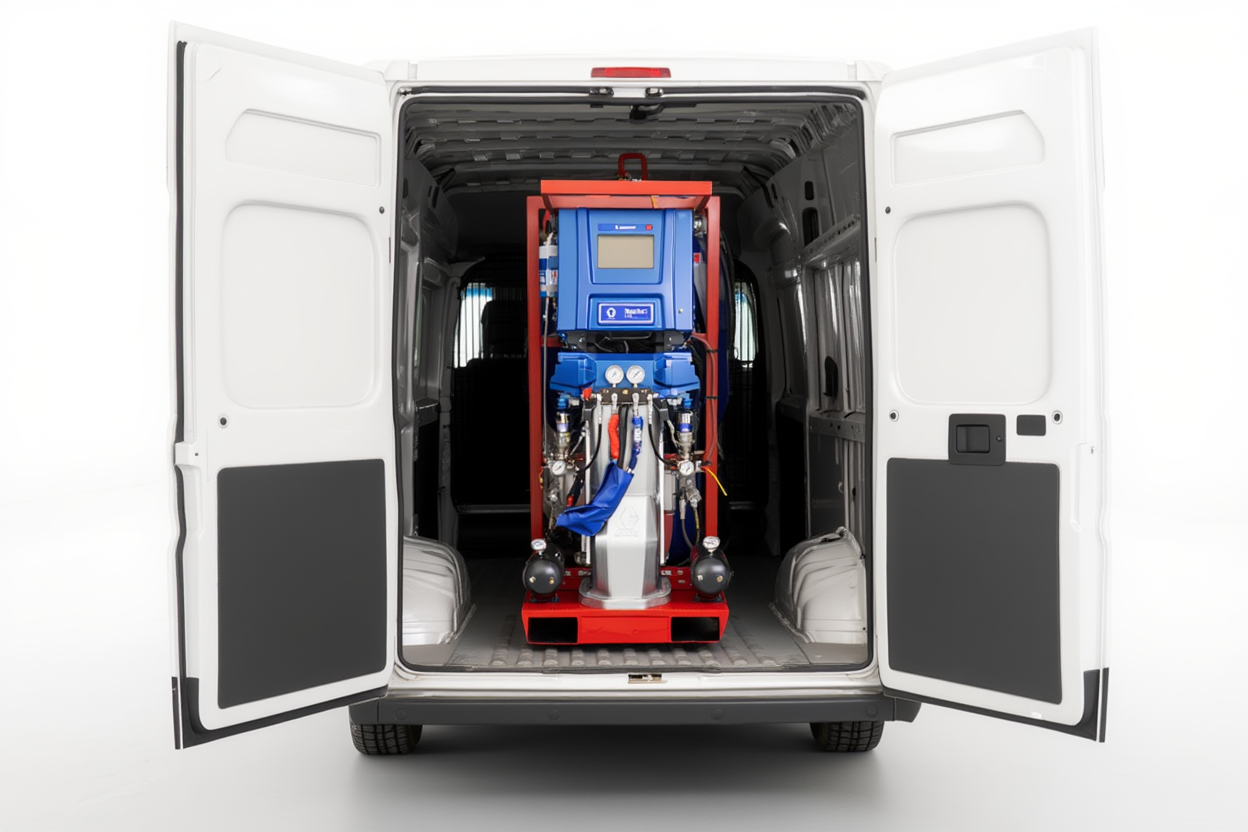
A spray foam van rig takes a different approach. The entire system is built inside a cargo van or box truck, making the operation self-contained and mobile. Van rigs cost less overall because the van serves as both the vehicle and the equipment housing, no trailer and no tow vehicle needed. They also fit through standard doorways and parking spaces, which gives contractors access to interior renovation jobs, high-rise buildings, and tight residential sites that trailer rigs physically cannot reach. For contractors operating in Fairfield County and across the tri-state region, where job sites range from suburban colonials to urban commercial buildings, that access advantage translates directly into more billable work.
A small spray foam rig or portable setup sits at the lowest price point, typically under $20,000. These are designed for contractors doing occasional spray foam work or very small jobs, touch-up applications, small crawl spaces, or supplemental insulation projects. They use lower-output proportioners, shorter hoses, and smaller compressors. While the entry cost is appealing, the limited production capacity means longer job times and lower daily revenue, which can make it harder to grow the business beyond a certain point.
The team at SprayAlliance focuses on building van-ready rigs that give contractors professional-grade output without the overhead of a trailer-based operation. The approach is designed for operators who want to start lean, move fast, and scale by adding rigs rather than adding complexity.
Along the I-95 corridor from Stamford through Greenwich and into Norwalk, contractors encounter job sites that range from waterfront estates near the Long Island Sound to tightly packed commercial buildings in downtown districts. A trailer rig that works well on a spacious suburban driveway in Greenwich may be impossible to position on a narrow lot in Norwalk’s older neighborhoods. Van-based rigs give contractors in Fairfield County the flexibility to bid on both types of work without turning down jobs because of access limitations.
What Costs Beyond the Rig Itself Should Contractors Plan For?
The rig is the centerpiece, but it is not the full spray foam startup cost. Contractors who budget only for equipment often find themselves short within the first few months of operation. A realistic startup plan accounts for several additional categories that are easy to overlook.
Training and certification typically cost between $1,500 and $5,000 depending on the program and length. Manufacturers like Graco offer equipment-specific training, and industry organizations provide broader certification courses that cover safety, application technique, and building code compliance. OSHA safety training is strongly recommended and in some states required for contractors working with spray polyurethane foam, particularly around respiratory protection and chemical handling.
Insurance is another significant line item. General liability insurance for a spray foam contractor typically runs $3,000 to $8,000 per year, and pollution liability, which covers chemical spills or off-gassing incidents, adds another $2,000 to $5,000 annually. Most commercial clients and general contractors require proof of both before allowing a spray foam crew on site.
Material inventory is an ongoing cost. A set of A-side and B-side chemical drums (typically sold in 55-gallon drum sets) costs roughly $1,500 to $3,000 per set depending on the foam type and supplier. A busy contractor may go through multiple sets per week. Personal protective equipment, respirators, suits, gloves, eye protection, adds several hundred dollars per month for a working crew.
Then there is spray foam equipment repair and maintenance. Proportioners, hoses, and spray guns are precision tools that need regular cleaning, filter changes, and occasional part replacement. Budgeting $2,000 to $5,000 per year for maintenance and unplanned repairs is a reasonable baseline. Contractors who skip maintenance to save money in the short term almost always end up paying more in downtime and emergency service calls. SprayAlliance helps property owners and contractors understand that equipment reliability is not a luxury, it is the foundation of a business that shows up on time, finishes on schedule, and gets called back for the next project.
For contractors exploring spray foam equipment financing, several options exist. Equipment loans, leases, and manufacturer financing programs can spread the initial capital outlay over two to five years. Financing does not eliminate the cost, but it reduces the cash needed on day one and allows the business to generate revenue while paying off the equipment. The key is understanding the total cost of financing, including interest and fees, and making sure projected job revenue comfortably covers the monthly payment along with all other operating expenses.
How much does it cost to start a spray foam business?
Starting a spray foam business typically costs between $50,000 and $150,000 when all expenses are included. The rig itself ranges from $15,000 to $60,000 depending on configuration. Training, insurance, licensing, material inventory, protective equipment, a vehicle, and first-year maintenance costs make up the rest. Financing options can reduce the upfront cash needed significantly.

What Should Contractors Evaluate Before Buying a Spray Foam Rig?
The right rig for one contractor may be the wrong rig for another. The most important factor is matching equipment to the type of work the business plans to take on. A contractor focused on residential attic insulation in suburban markets needs a different setup than one targeting commercial fireproofing or large-scale new construction. Output capacity, hose length, portability, and proportioner specifications all need to align with the jobs the contractor intends to bid on.
Warranty and manufacturer support matter as well. A rig is a production tool that runs hard, often in demanding conditions. Knowing what the warranty covers, how long it lasts, and how quickly the manufacturer or distributor can provide replacement parts or support is just as important as the sticker price. Contractors operating in the Stamford, CT area and across the Connecticut market benefit from working with regional equipment providers who can offer hands-on support rather than phone-only service from across the country.
Used rigs are another option worth considering. A well-maintained used rig can offer significant savings over buying new, but the risks are real. Spray foam proportioners have precise tolerances, and a machine with worn seals, damaged heaters, or outdated software can cost more to repair than it saved on the purchase price. Contractors looking at a used spray foam rig for sale should inspect the proportioner’s spray hours, maintenance records, and overall condition before committing.
Should a new spray foam contractor buy or lease equipment?
Both options work depending on the contractor’s financial situation. Buying builds equity and eliminates monthly payments once paid off. Leasing reduces upfront cash and may include maintenance coverage, but costs more over the long term. Many new contractors use equipment financing to buy while spreading payments over two to five years.
SprayAlliance focuses on long-term performance, safety, and efficiency when helping contractors select and configure spray foam rigs. The goal is not to sell the most expensive system available but to match the right equipment to the contractor’s market, budget, and growth plan. An on-site or virtual consultation is considered an industry best practice before committing to any rig purchase, and it provides the information needed to make a confident, well-informed decision.
Contractors and trade professionals looking for more information about rig configurations, equipment costs, or building a spray foam business can reach SprayAlliance Corp through their website. The company operates from Stamford, CT and serves contractors across the NY / NJ / CT tri-state region and nationwide.
Additional information is available at: https://sprayalliance.com/
 Dubb
Dubb