
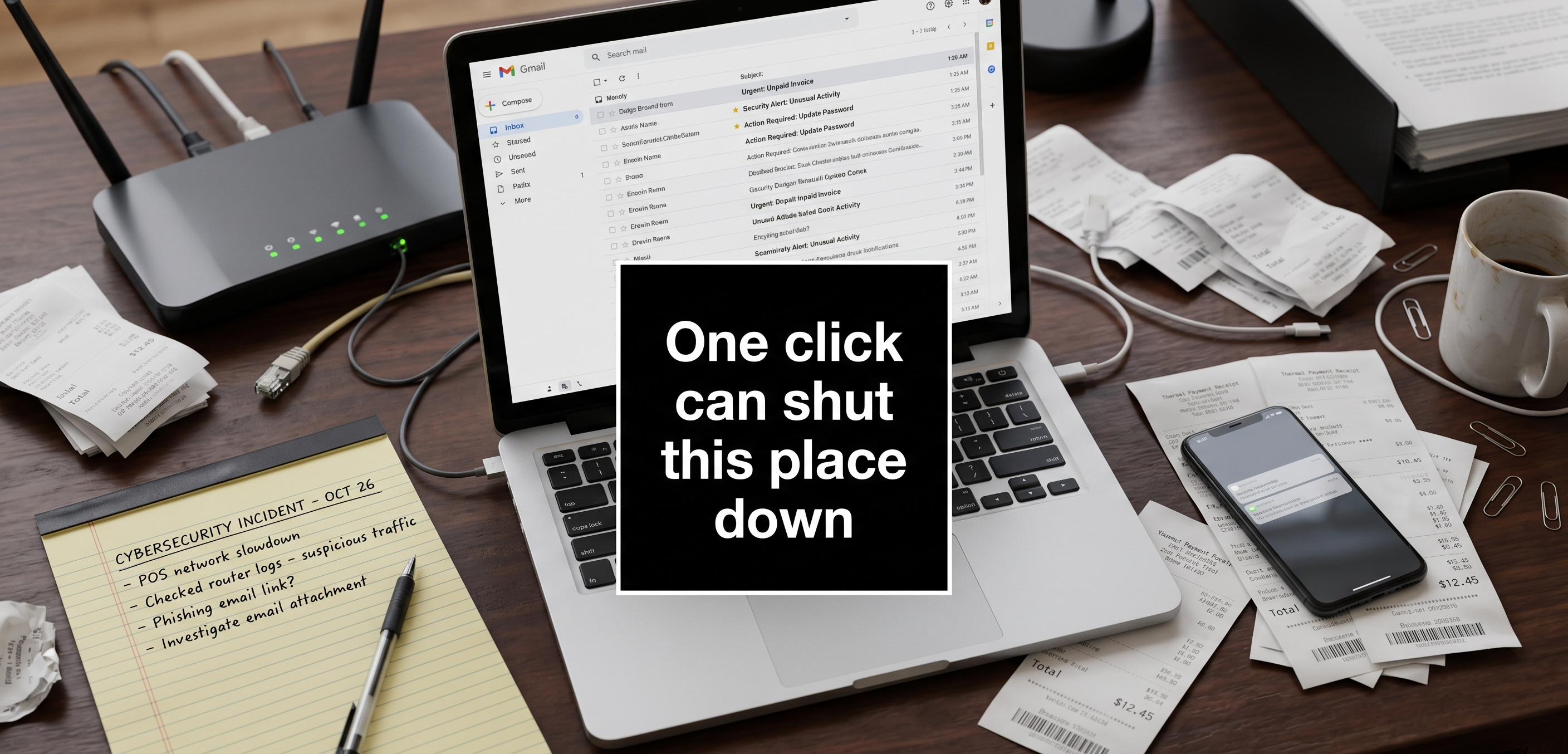
Restaurants have become digital businesses whether they planned to or not. Ordering systems, payment terminals, online reservations, loyalty programs, delivery platforms, payroll tools, vendor logins, Wi-Fi networks, and cloud-based management systems now sit inside ordinary daily operations.
That is why cybersecurity for restaurants can no longer be treated as a technical side topic. It is an operating-risk issue, a payment-risk issue, and in some cases a business continuity issue. The National Restaurant Association says restaurants should use safeguards such as firewalls, encryption, multi-factor authentication, and regular software updates, and it stresses that restaurants should create a written cyber incident response plan because breaches, ransomware, and payment-card skimming can still happen even when basic protections exist.
What makes this issue different from many other business risks is that the damage is not always visible at first. A wet floor can be seen. A broken cooler can be heard. A phishing email, a weak password, or insecure remote access can sit quietly until customer data, payment information, or core operating systems are compromised. T
So the real shift is this: cybersecurity for restaurants is no longer just an IT issue. It is part of restaurant risk management. A cyber incident can interrupt sales, disrupt payments, damage customer trust, trigger notification obligations, create regulatory or contractual problems, and force a restaurant to spend money on forensics, legal review, system recovery, and public response.
The FTC’s business breach guidance says companies should move quickly to secure systems, fix vulnerabilities, assemble a response team, and determine the source and scope of the breach. That is not the language of a minor inconvenience. It is the language of a serious business event.
Why Cybersecurity for Restaurants Is No Longer Optional
For a long time, many operators could tell themselves that cybersecurity was mainly an issue for banks, large retailers, or tech firms. That position is harder to defend now. Restaurants hold payment data, employee data, business records, and often customer contact details. They also rely on multiple systems and vendors to keep service moving.
The National Restaurant Association says restaurants should train employees to handle phishing and data safely, secure their networks, use strong passwords and multi-factor authentication, update software regularly, use PCI-compliant secure payment processing, encrypt sensitive data, and back data up to a secure offsite location.
That guidance matters because cybersecurity for restaurants is not only about sophisticated attacks. In many cases, the problem starts with ordinary weaknesses: a reused password, an unpatched system, remote access left too open, or an employee who clicks the wrong email under pressure. The PCI Security Standards Council states that weak and default passwords are one of the leading causes of payment-data breaches, and it says insecure remote access is also one of the leading causes of breaches for businesses.
Once that is understood, the topic becomes much more practical. The restaurant does not need to think like a software company. But it does need to recognize that ordinary restaurant systems now create ordinary cyber exposure. A business that processes cards, stores customer information, uses vendor-connected tools, or depends on digital operations already has a cyber posture, whether or not management has actively defined one.
Payment Systems Make Cybersecurity for Restaurants a Revenue Issue
One reason cybersecurity for restaurants matters so much is that restaurants are payment-heavy businesses. The PCI Security Standards Council’s merchant resources are built around the fact that small businesses need simple, usable guidance to protect customer payment data. PCI also warns that criminals can attach skimming devices to card readers and steal customer payment data, then use that stolen data to create counterfeit cards and make illegal purchases.
This is not a narrow technical problem. It is tied directly to revenue and customer confidence. If payment systems are compromised, the restaurant is not just dealing with a back-office issue. It is dealing with the possibility that customers’ card data was exposed, that transactions were affected, or that systems need to be taken offline.
The National Restaurant Association has said plainly that cybersecurity is emerging as one of the biggest risk factors for the industry’s reputation and bottom line, and that businesses under pressure can let their guard down during busy periods.
That is why cybersecurity for restaurants is also a payment-security issue. Restaurants do not need to become experts in every standard, but they do need to understand the practical consequence: payment systems are part of the brand experience, the customer trust equation, and the daily revenue engine. A payment-related cyber problem is not abstract. It can hit the restaurant where the business is most exposed: the point where money changes hands.
Phishing Is Still One of the Easiest Ways In
Many restaurant owners imagine cyberattacks as highly technical intrusions. Often they are more ordinary than that. The FTC’s small business cybersecurity guidance gives a simple example: an employee receives an email that appears to be from a vendor asking them to click a link and update an account, or from a boss asking for a password. The FTC says those may be phishing attempts and recommends hovering over links before clicking, checking for spoofed email addresses, training staff, keeping security up to date, and giving employees a way to report suspicious messages.
This is especially relevant to cybersecurity for restaurants because restaurant environments are busy, interrupt-driven, and often understaffed. Managers handle payroll, invoices, reservations, delivery apps, staffing messages, and vendor communication all at once. That makes the restaurant environment a plausible target for phishing because urgency and distraction are already built into the workday.
The FTC also notes that phishing can lead to much broader damage: stolen credentials, access to banking information, malware infections, and ransomware incidents. It recommends that if a phishing scheme succeeds, businesses should immediately change compromised passwords, disconnect infected devices, follow internal procedures, notify affected customers when required, and report the incident.
So when discussing cybersecurity for restaurants, phishing deserves more weight than it often gets. It is not just an employee mistake topic. It is one of the most common doors through which a larger operational problem can begin.
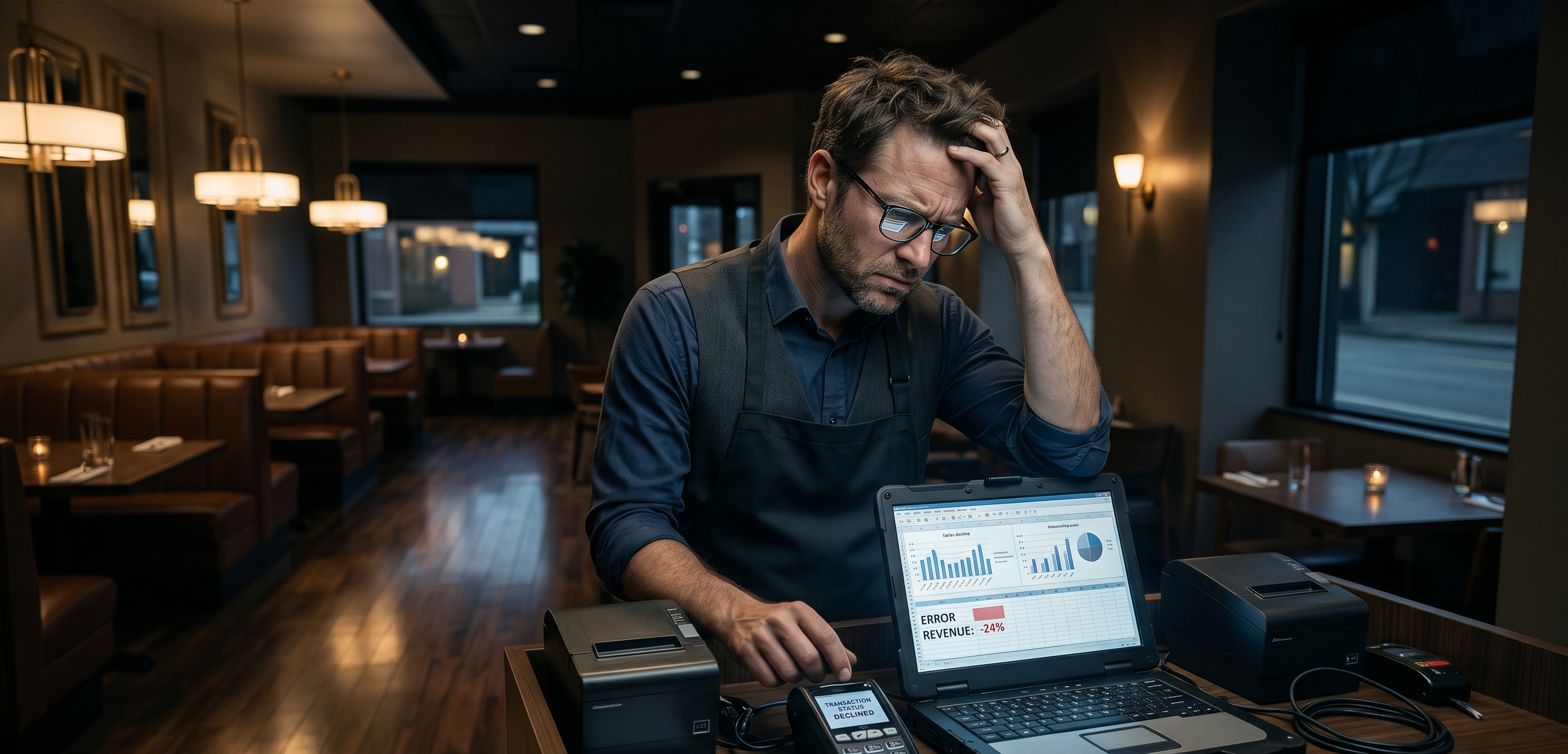
Ransomware Turns Cybersecurity for Restaurants Into a Continuity Problem
Some cyber risks are mainly about data exposure. Others threaten the ability to operate at all. Ransomware belongs firmly in the second category. The FTC says ransomware often begins with phishing emails, malicious attachments, exploited server vulnerabilities, infected websites, or insecure remote access. It also says businesses should have a plan to keep running after a ransomware attack, regularly back up important data to systems not connected to the network, and train staff to recognize phishing and related infection paths.
That matters because cybersecurity for restaurants is also about business continuity. If a restaurant loses access to ordering tools, payment systems, staff records, reservations, or internal files, the operational consequences can arrive quickly. A restaurant can tolerate some disruptions better than other businesses, but it also depends on fast-moving coordination. If the systems supporting that coordination are locked or unreliable, the business may face lost sales, confusion, and degraded customer experience almost immediately.
The FTC’s response guidance is explicit: if a business is attacked, it should disconnect infected devices, launch an investigation, involve experienced IT or third-party cybersecurity staff, contact authorities, and implement its continuity plan. It also warns that paying ransom does not guarantee data recovery.
The broader lesson is straightforward. Cybersecurity for restaurants is not just about preventing embarrassment. It is about protecting the ability to function when a digital problem becomes an operational outage.
Vendor Access Is Part of Cybersecurity for Restaurants Too
Restaurants rarely operate on a single closed system. They use payment vendors, POS providers, payroll services, reservation platforms, accounting tools, scheduling systems, loyalty programs, and delivery integrations. That means restaurant cyber risk often extends beyond devices the operator physically owns.
The FTC’s small business cybersecurity guidance specifically says businesses should assess cybersecurity risks posed by suppliers and other third parties before entering formal relationships, and it recommends documenting legal, regulatory, and contractual requirements. It also advises businesses to ask whether cybersecurity insurance is appropriate and to assess the risks posed by vendors.
The PCI Security Standards Council reinforces that concern by providing resources specifically called “Questions to Ask Your Vendors,” along with simplified materials for small merchants trying to understand common payment systems and vendor-related security issues.
This is one reason cybersecurity for restaurants should not be framed as “protecting our own computers” only. A restaurant may be exposed through remote support, third-party software, vendor credentials, or systems connected to payment flows. Even if the restaurant is not highly technical, management still has a practical responsibility to understand who touches its systems, how access is controlled, and what basic questions should be asked before trusting a provider.
This point is often underestimated because vendor relationships feel operational rather than cyber-related. But when external access exists, vendor risk becomes part of the restaurant’s cyber posture whether the operator likes it or not.
Staff Training Is Not a Side Detail
The National Restaurant Association says restaurants should train staff to recognize and respond to potential cyberattacks, and the FTC says businesses should create a culture of security by training employees regularly and updating them as new risks emerge. It also recommends tracking training participation and making incident response part of normal preparation.
That matters because cybersecurity for restaurants often rises or falls on routine human behavior. The business may have decent systems, but one weak login habit or one rushed click can still open the wrong door. In restaurant environments, training can feel easy to postpone because daily operations already consume attention. But the same argument could once have been used against food-safety training or alcohol-service training. Over time, those became recognized as operating essentials. Cyber training is moving in the same direction.
This does not mean every restaurant needs an elaborate security department. It means the business should create repeatable habits: suspicious emails should be recognized and escalated; password-sharing should be treated seriously; device loss should trigger immediate action; and everyone should know what to do when something seems wrong. The FTC’s guidance repeatedly emphasizes that employees should know how to report incidents, preserve security practices during travel or remote work, and follow a response plan when something goes wrong.
So if the question is whether staff training belongs in cybersecurity for restaurants, the answer is yes. In many cases, it is one of the most practical controls a restaurant can actually implement.

Cybersecurity for Restaurants Includes an Incident Response Plan
One of the strongest points in the National Restaurant Association’s current guidance is that restaurants should have a written incident response plan. The Association says that without a plan, every minute of confusion increases damage, costs, and loss of customer trust, while a written and tested plan helps staff know whom to call, what to do, how to contain the problem, how to notify customers or regulators, and how to restore systems quickly.
The FTC’s data breach guidance aligns with that view. It says businesses should mobilize a breach response team right away, secure systems, fix vulnerabilities, work with forensics experts, and consult legal counsel when needed.
This is an important point because cybersecurity for restaurants is often discussed as prevention only. Prevention matters, but response quality matters too. A restaurant may not stop every incident. It can still reduce confusion, contain damage faster, and avoid avoidable mistakes if the response structure already exists.
A practical incident response plan for a restaurant does not need to be theatrical. But it should answer basic questions: Who gets called first? Who can shut down access? Where are backups? Who decides whether law enforcement, counsel, or a forensic vendor needs to be involved? If those answers do not exist before an incident, the business is likely to lose time when time matters most.
Cyber Insurance Belongs in the Conversation
The FTC’s cybersecurity guidance includes a dedicated section on cyber insurance and says recovering from a cyberattack can be costly. It notes that cyber insurance may help with first-party and third-party losses, including legal counsel, data recovery, customer notification, lost income due to business interruption, forensic services, lawsuits, regulatory inquiries, and other expenses depending on policy structure.
That does not mean insurance replaces security. Restaurants should understand that cyber incidents can create both direct internal costs and liability to others. Those two sides do not always map neatly onto general business coverage assumptions.
This is where broader risk management becomes relevant inside the article’s business frame. A restaurant looking at cyber exposure should not think only in terms of software settings. It should also think about whether a serious incident would create first-party losses, third-party claims, interruption costs, customer-notification expenses, or regulatory response costs.
The FTC also says businesses should examine policy details carefully and understand whether coverage extends to vendor-related attacks, breach response support, regulatory defense, and business interruption. That is a useful reminder that the insurance side of cybersecurity for restaurants is not automatic. It requires review, not assumption.
Cybersecurity for Restaurants Is Also About Reputation
Restaurants depend on trust in unusually direct ways. Customers hand over payment cards, contact details, and sometimes loyalty information in exchange for what is supposed to be a routine dining transaction. If that process feels unsafe, the damage can spread beyond the immediate technical problem. The National Restaurant Association has said cybersecurity is one of the biggest risk factors for the industry’s reputation and bottom line.
That is why cybersecurity for restaurants is not just a defensive technical issue. It affects how stable, competent, and trustworthy the business appears when something goes wrong. The FTC’s breach guidance, with its focus on fast containment, investigation, and customer notification, reflects the fact that response quality influences public trust as well as compliance.
This is especially important for restaurants because the brand relationship is repetitive. Guests return often. They use stored cards, repeat ordering systems, and familiar platforms. A cyber event can therefore reshape not just one transaction, but the customer’s view of the restaurant as a reliable place to do business.

A Practical Review of Cybersecurity for Restaurants
A practical review starts by dropping the idea that cybersecurity belongs only to specialists. The FTC’s framework for small businesses says companies should inventory the hardware, software, data, POS devices, and services they rely on; require multi-factor authentication; update software regularly; limit access to sensitive assets; encrypt sensitive data; back up data; monitor for unauthorized access; and create a response plan.
The National Restaurant Association adds restaurant-specific urgency by telling operators to secure networks, train staff, implement PCI-compliant secure payment processing, back up data offsite, and prepare a written incident response plan.
So a practical cybersecurity for restaurants review should include questions such as these: What payment systems are in use? Who has remote access? Are default passwords gone? Is multi-factor authentication active? Do employees know how to spot phishing? Are backups separated from the main network? Does management know what to do in the first hour after an incident?
This is also where restaurant and entertainment insurance and broader business coverage conversations may intersect with digital exposure, especially when restaurants depend heavily on payment systems, reservations, off-premises ordering, and customer data flows. The point is not to force every restaurant into a complex compliance mindset. I
A Calm Conclusion on Cybersecurity for Restaurants
Restaurants are increasingly digital whether they describe themselves that way or not. Payment systems, vendor access, online ordering, reservations, loyalty tools, and employee-facing systems all create efficiency, but they also create exposure. Official guidance from the National Restaurant Association, the PCI Security Standards Council, and the FTC all point in the same direction: businesses should secure payment systems, use strong passwords and multi-factor authentication, train staff, keep software updated, back up data, evaluate vendor risk, and prepare a response plan before a cyber incident occurs.
That is why cybersecurity for restaurants is no longer just an IT issue. It is a restaurant issue. It touches payments, customer trust, continuity, staffing, vendor control, and insurance review. A restaurant does not need to become a technology company to take the problem seriously. It simply needs to recognize that digital systems now sit too close to the heart of operations to be treated as an afterthought.

 Dubb
Dubb

 USA.CIS