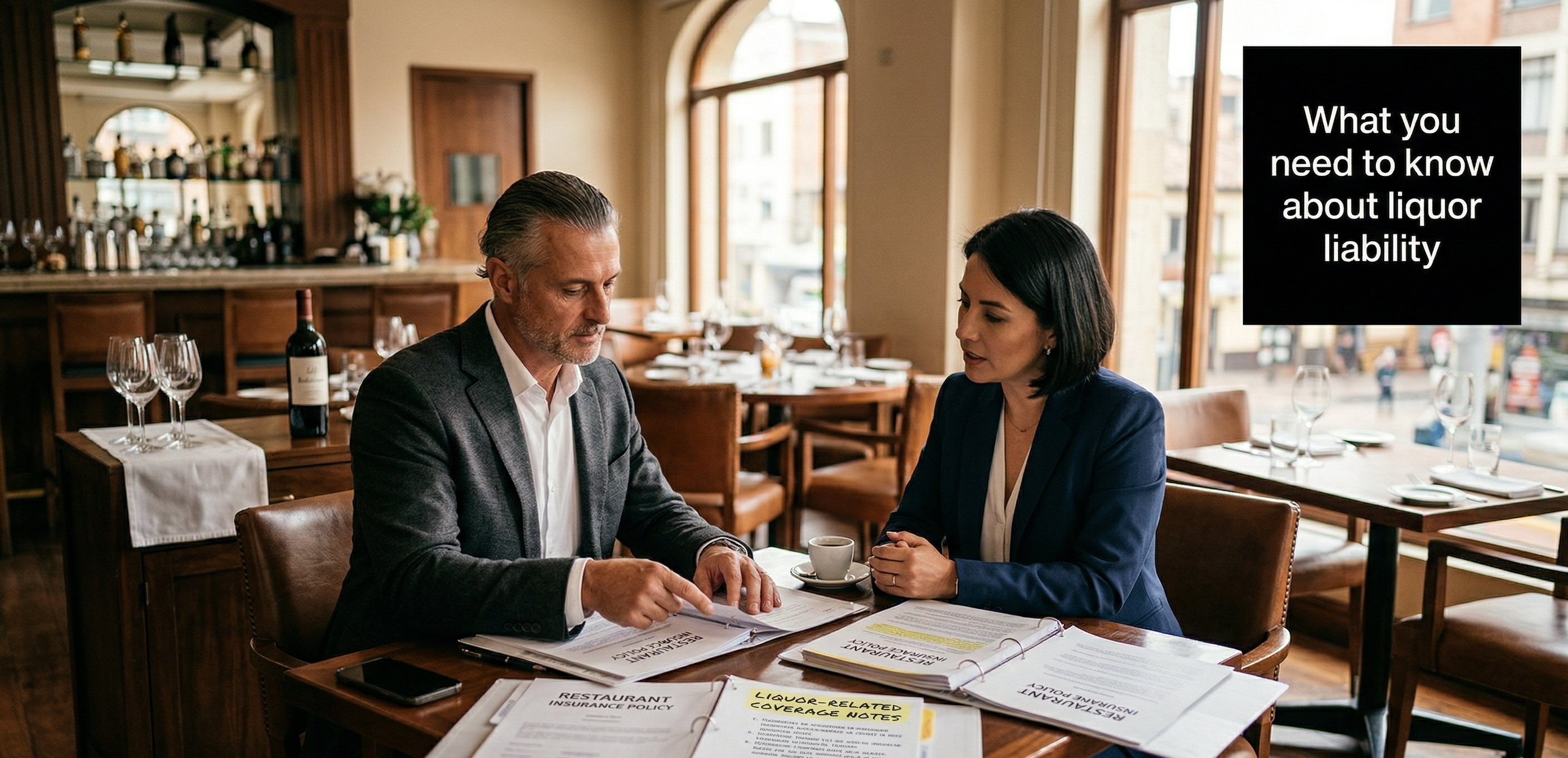

If you own a restaurant, you likely think first about visible losses: a broken freezer, a damaged dining room, spoiled inventory, or repairs after a storm. But business interruption risks for Florida restaurants are often more damaging because they extend beyond physical damage and directly affect revenue, payroll pressure, vendor obligations, and the ability to reopen quickly. The U.S. Small Business Administration states that business insurance protects against the unexpected costs of running a business and warns that accidents, natural disasters, and lawsuits could run a business out of operation.
For restaurants in Florida, that risk deserves special attention because closures can happen for more than one reason. Hurricanes, flooding, power outages, fire damage, lack of hot water, sewage problems, pest issues, and refrigeration failures can all disrupt service. Florida’s Division of Hotels and Restaurants explains that conditions warranting immediate closure can include lack of approved utilities or hot water, sewage backups or overflows, fire damage, pest infestation, or inadequate refrigeration. It also states that emergency closures are taken to mitigate elevated risk to the health, safety, or welfare of the public or employees, and that the establishment remains closed until conditions are corrected.
That is why business interruption for Florida restaurants is not just an insurance phrase. It is an operating reality. A restaurant does not need to suffer total destruction to lose income. A few days of closure after a sanitation issue, storm event, utility problem, or property damage incident can create immediate pressure on cash flow and staffing, especially in businesses already operating on tight margins. The SBA has also noted that business interruption insurance helps businesses pay bills if a storm or other event closes their facility and that, depending on the policy, it may also cover some lost profits.
Why Business Interruption Risks for Florida Restaurants Are Often Underestimated
One reason business interruption risks for Florida restaurants are often underestimated is that owners tend to focus on the triggering event rather than the downtime that follows. A storm is seen as the problem. A fire is seen as the problem. A failed refrigeration system is seen as the problem. In reality, the interruption to operations may be the more serious financial issue because revenue can stop while payroll, rent, debt obligations, and supplier relationships continue.
The SBA’s continuity and insurance guidance points toward this broader business reality. It recommends that businesses prepare for emergencies and build continuity planning into how they operate, and it notes that time out of operation has real financial consequences for small businesses. Ready.gov makes the same point more directly in its business preparedness materials, emphasizing business continuity planning and continuity of operations planning as part of disaster readiness.
Restaurants are especially vulnerable because closure affects more than a physical premises. It affects reservations, customer habits, spoilage risk, staffing schedules, and community visibility. A retail office that closes briefly may sometimes restart without the same level of operational friction. A restaurant closure can interrupt a more delicate chain of inventory flow, labor coordination, and daily cash turnover.
What Counts as Business Interruption for a Restaurant
From a restaurant owner’s perspective, restaurant business interruption Florida exposure begins when the business cannot operate normally and earn expected revenue because a covered event or serious disruption interferes with operations. The interruption may be dramatic, such as hurricane-related damage. It may also be less dramatic but still commercially serious, such as fire damage in a kitchen zone, an inspection-related closure, a utility problem, or an event that makes the premises temporarily unsafe or unusable.
Florida’s inspections guidance for hotels and restaurants states that an “Emergency Order Recommended” status applies when conditions are found that endanger the health and safety of the public and require immediate closure of the establishment. The Division’s public-records explanation further clarifies that immediate closure may be tied to conditions such as sewage overflows, lack of hot water, fire damage, pest infestation, and inadequate refrigeration.
These examples matter because they show that Florida restaurant closure risks are not limited to hurricanes or catastrophic building loss. The interruption can come from operational conditions that make continued food service noncompliant or unsafe. In financial terms, the effect can still look similar: closed doors, lost revenue, staffing pressure, and a rush to restore operations.
Hurricanes and Severe Weather Are an Obvious Florida Trigger
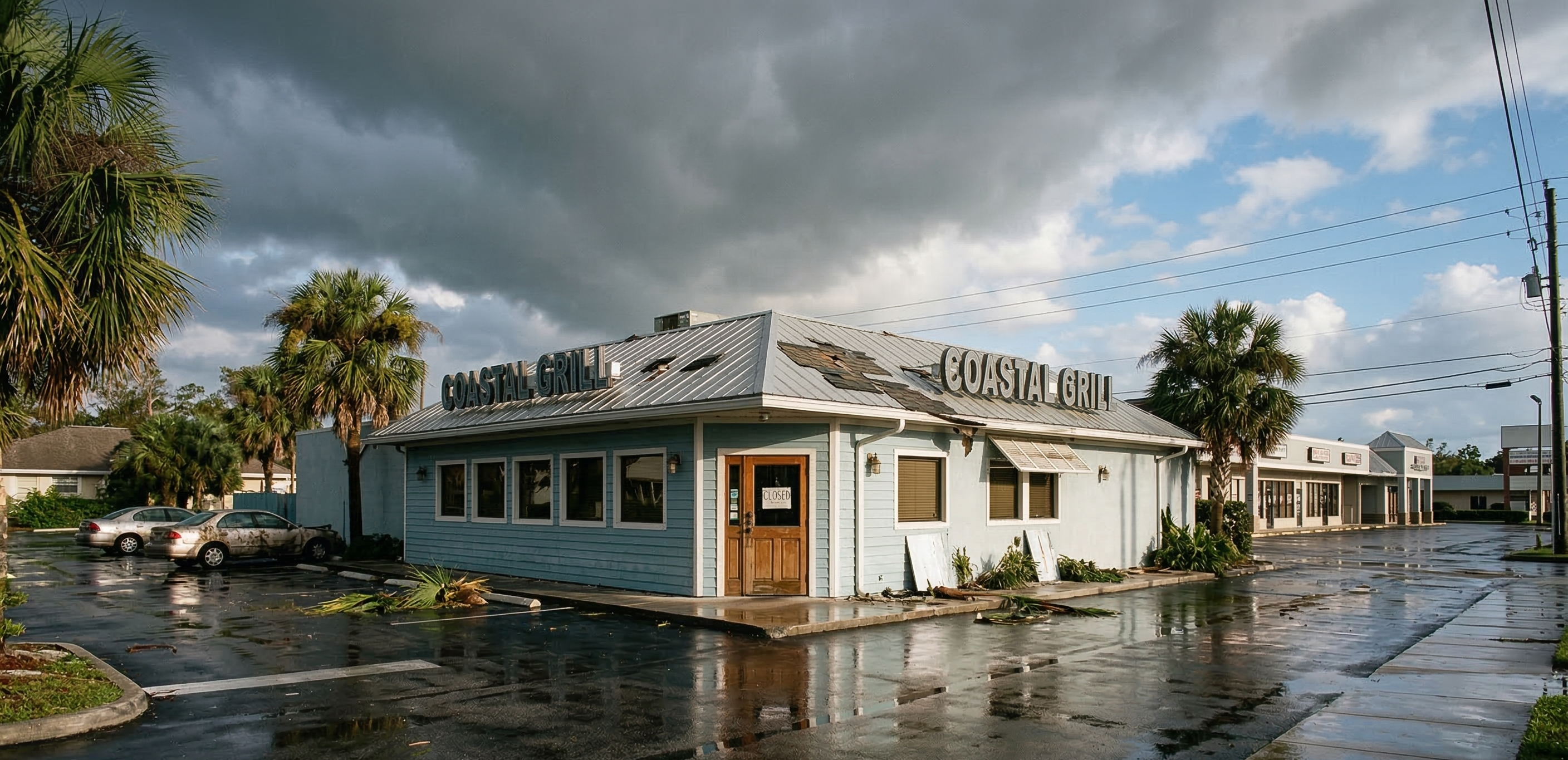
Florida restaurants cannot discuss interruption risk without discussing storms. Ready.gov’s hurricane toolkit for businesses is built around preparedness and continuity planning, reflecting the fact that hurricanes can disrupt operations well beyond the moment of landfall. The SBA likewise advises businesses to prepare for emergencies and points to resilience planning as part of recovery readiness.
For restaurants, storm-related interruption is rarely just a roof problem. A hurricane or severe weather event can affect:
-
access to the premises,
-
power reliability,
-
refrigeration stability,
-
inventory preservation,
-
supplier routes,
-
staffing availability,
-
safe reopening timelines.
Even if the building survives reasonably well, downtime may continue because supporting systems do not return immediately. FEMA’s business resources for Florida and broader preparedness materials emphasize preparedness, mitigation, and recovery planning because the business impact of disasters often goes beyond initial damage.
This is one reason business interruption insurance for restaurants becomes part of a larger resilience conversation rather than a narrow claims conversation.
Sanitary Closures Can Create Serious Downtime Even Without Major Structural Damage
One of the most important restaurant-specific points is that a closure can happen even when the restaurant still looks “mostly fine.” Florida’s public food service oversight makes clear that immediate closure can be tied to conditions like sewage backups, lack of approved utilities or hot water, pest infestation, fire damage, or inadequate refrigeration.
That is a crucial distinction for restaurants because food service businesses are judged not only by structural usability, but also by sanitation and safety conditions. A restaurant may still have tables, walls, and equipment in place and yet remain unable to operate legally or safely because of utility failure, contamination conditions, or refrigeration problems. Florida’s inspection page also indicates that an emergency closure recommendation applies when conditions endanger the public.
This helps explain why business interruption risks for Florida restaurants are different from interruption risks in many other small businesses. Restaurants are more dependent on utility integrity, temperature control, sanitation status, and inspection-sensitive operations. The path from “problem” to “closure” can therefore be shorter.
Property Damage Is Only Part of the Loss Story
A major mistake in restaurant insurance planning is to think that if property damage is addressed, the interruption problem is solved. It is not. Property damage and business interruption are related, but they are not identical financial problems. The SBA explicitly notes that business interruption insurance helps businesses pay bills if a storm or other event closes down the facility, and it says such coverage may also cover some lost profits depending on the policy.
For restaurants, that matters because the real pain after a closure is often a combination of losses:
-
stopped sales,
-
wasted inventory,
-
fixed expenses that continue,
-
pressure to retain staff,
-
vendor disruptions,
-
reopening delays,
-
customer drift toward competitors.
A restaurant may technically repair a physical issue and still remain financially strained because the interruption period created revenue damage that property repair alone does not erase.
Power, Refrigeration, and Utility Problems Can Escalate Fast
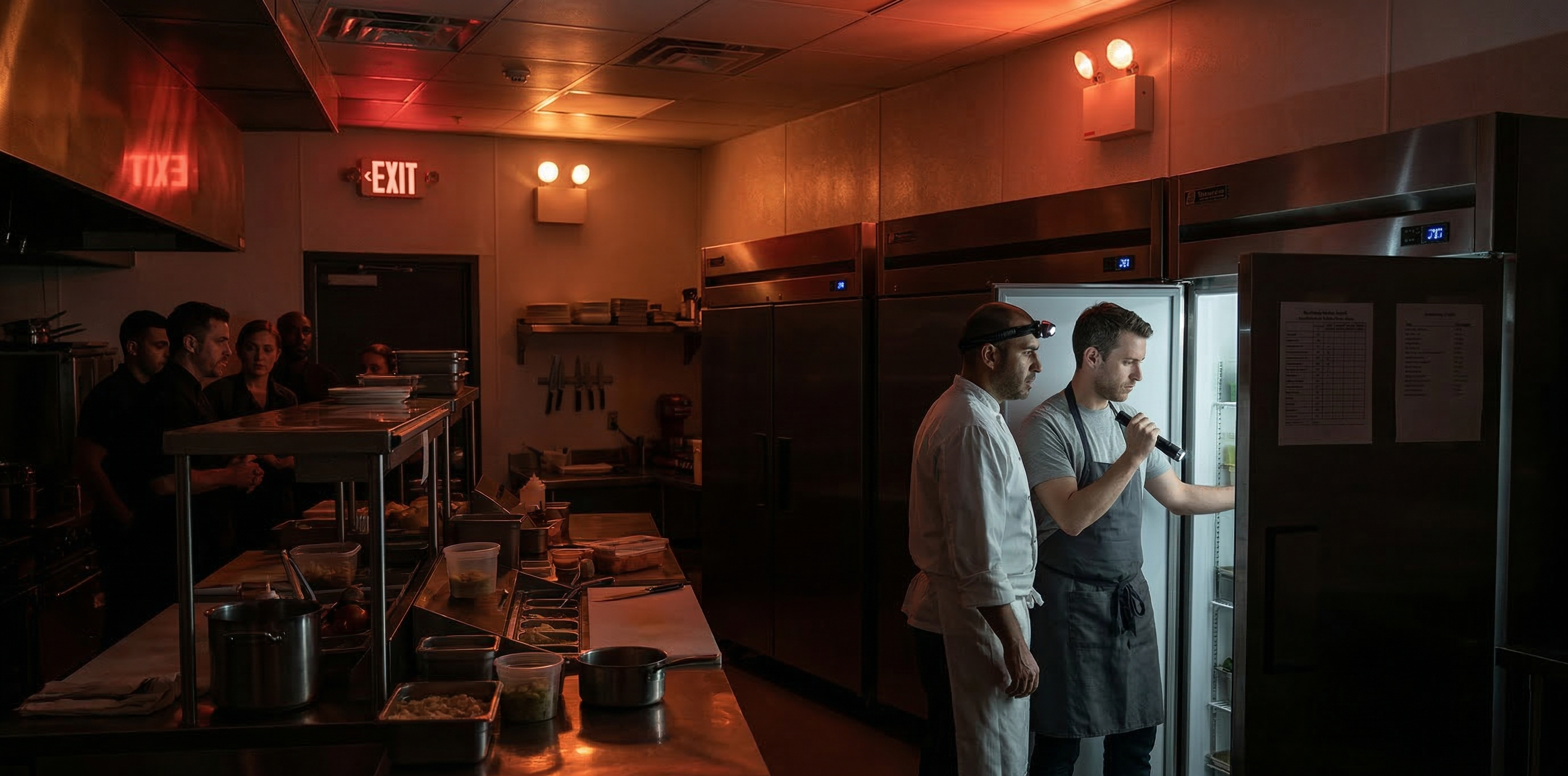
Restaurants rely on utility stability more intensely than many other businesses. Refrigeration problems, lack of hot water, insufficient approved utilities, and related infrastructure failures are not minor inconveniences in food service. Florida’s public-records guidance expressly lists lack of approved utilities or hot water and inadequate refrigeration as conditions that can warrant immediate closure.
From an interruption perspective, this matters because downtime may begin before any large repair project is underway. A restaurant can lose operating ability quickly if temperature-sensitive inventory becomes unsafe, dishwashing and sanitation processes cannot be maintained, or utility-dependent food service functions are interrupted.
Ready.gov’s continuity materials reinforce the importance of planning for this sort of disruption rather than assuming recovery will be simple. Business continuity planning exists precisely because interruptions often result from operational dependencies, not only visible structural damage.
For Florida restaurants, that means restaurant downtime risks Florida include utility-related scenarios that may not initially look like “insurance events” to owners but can still create substantial business loss.
Fire Damage and Cleanup Delays Can Disrupt More Than the Kitchen
Fire is another interruption trigger that often gets understood too narrowly. Florida’s restaurant public-records guidance lists fire damage as a condition that may warrant immediate closure. Even a localized fire or smoke event in a restaurant can affect food safety, cleaning requirements, inspections, equipment usability, and reopening timelines.
OSHA’s restaurant safety materials also identify fire risk as a real workplace hazard, including risks related to poor housekeeping, faulty electrical cords, and grease-related conditions. (osha.gov) That matters because fire risk is not only a safety issue. It is also a downtime issue. When cleanup, inspection, repairs, and safe reopening all take time, the restaurant may face a loss period that outlasts the initial damage event.
For small restaurants especially, a short interruption after a fire event can trigger a longer commercial problem if customer habits shift or staffing becomes unstable.
Staffing and Revenue Pressure Continue During a Closure
A shutdown does not freeze the rest of the business. This is one reason business interruption for Florida restaurants can be so financially painful. During downtime, many obligations keep moving:
-
rent or mortgage obligations,
-
equipment financing,
-
payroll decisions,
-
insurance payments,
-
vendor relationships,
-
tax and accounting obligations.
The SBA’s discussion of business interruption coverage is relevant precisely because it frames interruption in terms of bills and lost profits during a shutdown period. For restaurants, the staffing side may be especially difficult. Employees may need hours, may seek temporary work elsewhere, or may not be available when the restaurant is finally ready to reopen. That can turn a one-week closure into a much longer recovery issue operationally.
The closure itself is only one stage. The reopening process has its own cost.
Why Business Continuity Planning Matters Alongside Insurance
Insurance is only part of interruption preparedness. The SBA’s emergency-preparation guidance specifically encourages businesses to prepare for emergencies, and Ready.gov’s business preparedness resources focus on continuity planning, continuity of operations, and readiness tools for disruptions such as hurricanes and severe weather.
For restaurants, continuity planning may include:
-
backup communication plans,
-
vendor contingency planning,
-
refrigeration and inventory protocols,
-
reopening checklists,
-
payroll and staffing contingencies,
-
documentation procedures after closure events,
-
review of insurance language before a loss occurs.
This matters because a restaurant with insurance but no operational continuity planning may still lose valuable time in the confusion that follows a shutdown. In many cases, speed matters nearly as much as the coverage itself.
How This Relates to CIS’s Restaurant Insurance Approach
CIS’s current restaurant and entertainment insurance positioning is built around the idea that restaurants face multiple overlapping risks. Its restaurant page lists property insurance, liability insurance, workers’ compensation, commercial auto, crime insurance, cyber liability, and equipment breakdown insurance as relevant restaurant coverages. That broader structure fits the interruption conversation because restaurant closures rarely affect only one category.
A closure after a storm, refrigeration failure, fire event, or sanitation issue may trigger questions about property loss, spoiled inventory, payroll pressure, equipment breakdown, and the time needed to reopen. Treating business interruption as just an abstract add-on misses how central it is to restaurant survival.
For an agency that positions itself around commercial insurance with a focus on risk management, that kind of restaurant-specific review is commercially logical. CIS’s homepage explicitly frames the company as specializing in commercial insurance solutions with a focus on risk management, and its geographic footprint includes Florida along with several other states.
Practical Signs a Restaurant Is Exposed to Business Interruption Risk
There are several indicators that business interruption risks for Florida restaurants may deserve closer review.
The restaurant depends heavily on refrigeration and fresh inventory
Florida’s closure guidance specifically references inadequate refrigeration as a closure-triggering condition.
The business is highly exposed to storm seasons or utility disruptions
Ready.gov’s hurricane toolkit and preparedness materials exist because storm disruption can quickly evolve into continuity and revenue problems.
The restaurant has not reviewed what would happen if it closed for several days
The SBA’s business interruption discussion is directly relevant here because bills and some lost profit exposure may continue even while operations stop.
The owner thinks interruption only matters after catastrophic damage
Florida’s closure standards show that conditions like utility failures, sewage issues, pest infestation, or inadequate refrigeration can also shut a restaurant down.
The business has no continuity or reopening playbook
SBA and Ready.gov preparedness materials both support continuity planning as part of business resilience.
How Business Interruption Insurance Fits Into the Bigger Picture
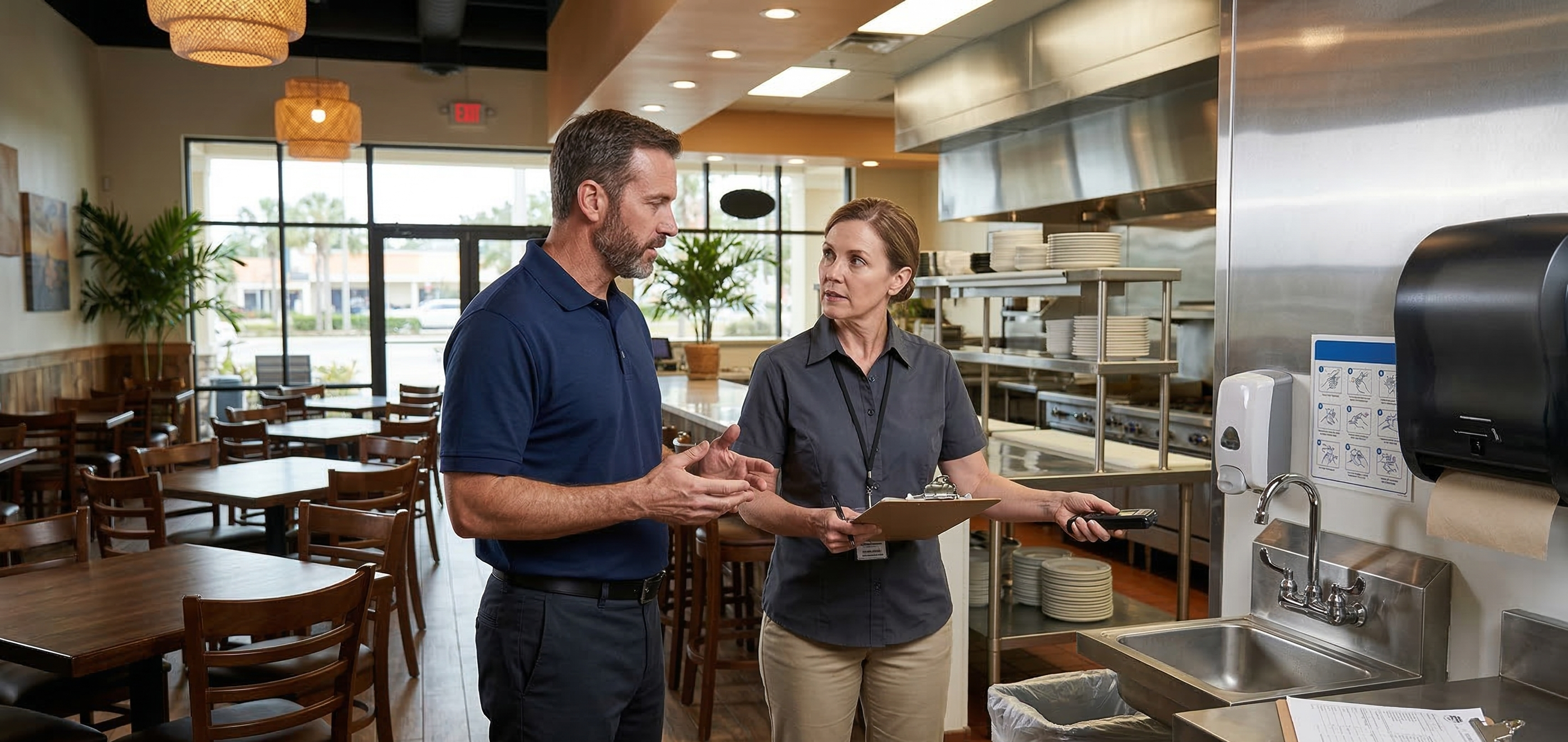
The practical takeaway is not that every interruption scenario is covered the same way. Insurance details still matter, and policy language always matters. But the SBA’s guidance is clear that business interruption insurance is designed to help businesses with bills during closure periods and may also help with some lost profits depending on the policy.
For restaurants, that means interruption review should not happen in isolation. It should sit alongside property review, equipment exposure, utility dependence, storm vulnerability, staffing plans, and sanitation-related closure risk. That layered approach is much more realistic for food service than a narrow conversation that only asks whether the building itself is insured.
This is also why CIS’s restaurant insurance structure, which combines multiple relevant coverage types rather than presenting one single restaurant policy as the answer to everything, fits the operational realities of the industry.
Final Thoughts
Business interruption risks for Florida restaurants are often more serious than owners expect because closure losses are rarely limited to damaged property. Florida restaurant shutdowns can follow storms, fire damage, sanitation problems, refrigeration failures, utility issues, and other conditions that make continued operation unsafe or noncompliant. Florida’s own restaurant oversight materials make that clear, and SBA guidance reinforces that business interruption can threaten a company’s ability to handle ongoing bills and revenue loss during downtime. </strong>
For restaurant owners in Florida, the smarter approach is to view interruption risk as part of a broader resilience strategy. That means looking at insurance, continuity planning, utility dependence, storm exposure, and reopening readiness together rather than assuming physical damage is the only problem worth insuring against. In an external editorial setting, this is the most natural place to connect readers with broader restaurant-specific coverage guidance.

 Dubb
Dubb
 USA.CIS