
In much of the residential construction industry, land is treated primarily as a legal condition. A parcel has setbacks, lot coverage limits, height restrictions, and septic requirements. Meet those requirements, pass the building department review, and the site has done its job. The house goes where it fits. The orientation follows the street. The grade gets cut or filled to accommodate the plan.
It’s an approach that produces buildings that are technically compliant and spatially generic, homes that could be anywhere, because they were designed without any particular commitment to being somewhere specific.
Wright Architects, a design firm based in New York’s Hudson Valley, takes a fundamentally different position. For the firm’s team of licensed architects and certified building performance specialists, the land isn’t a legal condition to be satisfied. It’s the starting point of the design, a specific, complex, and deeply informative landscape that tells the architect where the building wants to be, how it wants to face, and what it needs to become in order to belong to its place rather than merely occupy it.
That philosophy, applied consistently across years of residential practice in one of the Northeast’s most architecturally demanding regions, has positioned the firm at the forefront of a growing movement in custom residential design: one that treats site responsiveness not as a design preference but as a professional and ethical obligation. What distinguishes the firm’s approach isn’t a signature aesthetic or a particular building typology. It’s a commitment to starting every project with the land itself, studying it, listening to it, and designing outward from its specific conditions rather than imposing a predetermined solution onto it.
In practical terms, this means that no two Wright Architects projects begin the same way, because no two sites are the same. The wooded hillside parcel in Woodstock demands something entirely different from the open meadow lot outside Kingston, which demands something entirely different from the river-adjacent property in Saugerties with its flood plain considerations and sweeping western views. Site responsiveness, at its most rigorous, is an act of attention, the sustained, disciplined attention to a specific piece of land that makes genuine architectural belonging possible.
A Region That Demands More From Its Architecture
The Hudson Valley is not a forgiving context for careless design. Stretching roughly 150 miles along the western bank of the Hudson River from Westchester County north to the Capital District, the region encompasses an extraordinary range of terrain, from the steep, forested slopes of the Catskill foothills to the flat, river-adjacent flood plains of the mid-Hudson, from open agricultural meadows to dense mixed hardwood forests with ledge rock close to the surface.
The climate is equally demanding. Situated at the intersection of IECC Climate Zones 5 and 6, the region experiences significant heating loads through long, cold winters, humid and occasionally severe summers, and a freeze-thaw cycle that stresses building assemblies in ways that milder climates never encounter. Snow loads, ice damming, wind-driven rain, and ground frost depths are not theoretical concerns, they are site conditions that must be resolved in every set of construction documents produced for this region.
Ulster County, where much of Wright Architects’ practice is concentrated, adds a further layer of complexity through regulatory fragmentation. Zoning codes, building department capacity, and review timelines vary significantly from municipality to municipality. Kingston operates differently from Woodstock. Saugerties has a different review culture than New Paltz. A firm practicing across this landscape needs not just design expertise but deep familiarity with the regulatory fabric of a dozen or more jurisdictions, and the relationships, documentation habits, and sequencing strategies that allow projects to move through permitting without costly delays.
Wright Architects has built its practice within this complexity, and the firm argues that the complexity itself is generative. A region that demands this much from its architecture produces, when the work is done well, buildings of exceptional quality, homes genuinely responsive to their sites, deeply rooted in their landscape, and built to perform through conditions that would expose the weaknesses of less considered design.

Site Analysis as the Foundation of Design
The firm’s approach to every new project begins not with a floor plan but with a comprehensive site analysis, an extended study of the land that precedes any architectural decision. This process encompasses several distinct lines of inquiry that collectively shape the building before a single wall is drawn.
Solar analysis maps the path of the sun across the site throughout the year, identifying where direct solar gain is available in winter, how shadows fall from trees, terrain, and neighboring structures, and how the building can be oriented to take maximum advantage of passive solar heating while managing summer overheating risk. This analysis is conducted site-specifically rather than by applying regional averages, because the difference between a south-facing open meadow and a south-facing wooded slope in terms of winter solar access can be dramatic.
Wind and microclimate analysis examines prevailing wind patterns at the site and assesses how local topography modifies them. A valley floor site behaves very differently from a ridge-top site in terms of wind exposure, cold air drainage, and the micro-climatic conditions that affect both comfort and building durability.
Hydrological analysis traces how water moves across and through the site, where it collects, where it flows, where drainage patterns and seasonal water tables will constrain foundation decisions. In the Hudson Valley, where many desirable building sites involve wooded slopes, stream setbacks, and variable soil conditions, this analysis is often the most consequential early design input.
Regulatory mapping documents the full range of applicable zoning, building code, and environmental conditions, setbacks, lot coverage limits, height restrictions, septic and well requirements, wetland buffers, and overlay districts. This mapping isn’t treated as a constraint to work around but as part of the site portrait, information that shapes the design from the beginning.
The integration of these four streams of information produces a multi-layered understanding of the land that informs every subsequent design decision. The building that emerges is not designed and then placed on the site. It is developed from the site outward. This is the foundational discipline of Wright Architects’ Hudson Valley residential architecture practice, and it distinguishes the firm’s work from practices that treat site analysis as a preliminary formality rather than a generative design tool.
Passive Solar Design and the Science of Orientation
Among the most consequential site-responsive design decisions a residential architect makes is building orientation, the direction primary facades face and the relationship of glazing to solar exposure. Wright Architects treats orientation as both a performance decision and a design one, arguing that the two are inseparable in a climate like the Hudson Valley’s.
The basic physics are well established. A building with its long axis running east-west and its primary glazing on the south elevation captures low-angle winter sun, providing free passive heating during the months when heating loads are highest. North-facing glazing loses heat without providing meaningful solar gain. East and west elevations, if heavily glazed, can cause significant summer overheating. These principles have been understood for centuries, encoded in the vernacular architecture of every cold-climate region in the world, but are routinely ignored in contemporary residential construction.
Getting orientation right can reduce a building’s heating load by 15 to 30 percent compared to a randomly oriented equivalent, according to research through the U.S. Department of Energy’s residential building performance guidelines. That reduction requires no additional mechanical equipment or advanced materials, only that the building be placed on the site with intention, a decision that costs nothing if made at the beginning and cannot be undone once the foundation is poured.
Wright Architects integrates solar orientation analysis into schematic design rather than treating it as a post-design optimization. When site conditions create tension between optimal solar orientation and other priorities, the firm works through those tensions explicitly, helping clients understand the performance implications before choices are locked in.
The firm’s passive solar strategy extends to overhang design, calculating roof overhangs to block high-angle summer sun while admitting low-angle winter sun, and thermal mass specification, selecting materials with appropriate heat capacity to absorb solar gain during the day and release it gradually at night. These strategies, applied in combination, produce buildings that maintain stable interior temperatures with less mechanical intervention, a quality-of-life benefit that complements energy cost savings and that occupants consistently describe as one of the most noticeable qualities of a well-designed high-performance home.
The Envelope-First Approach to High Performance
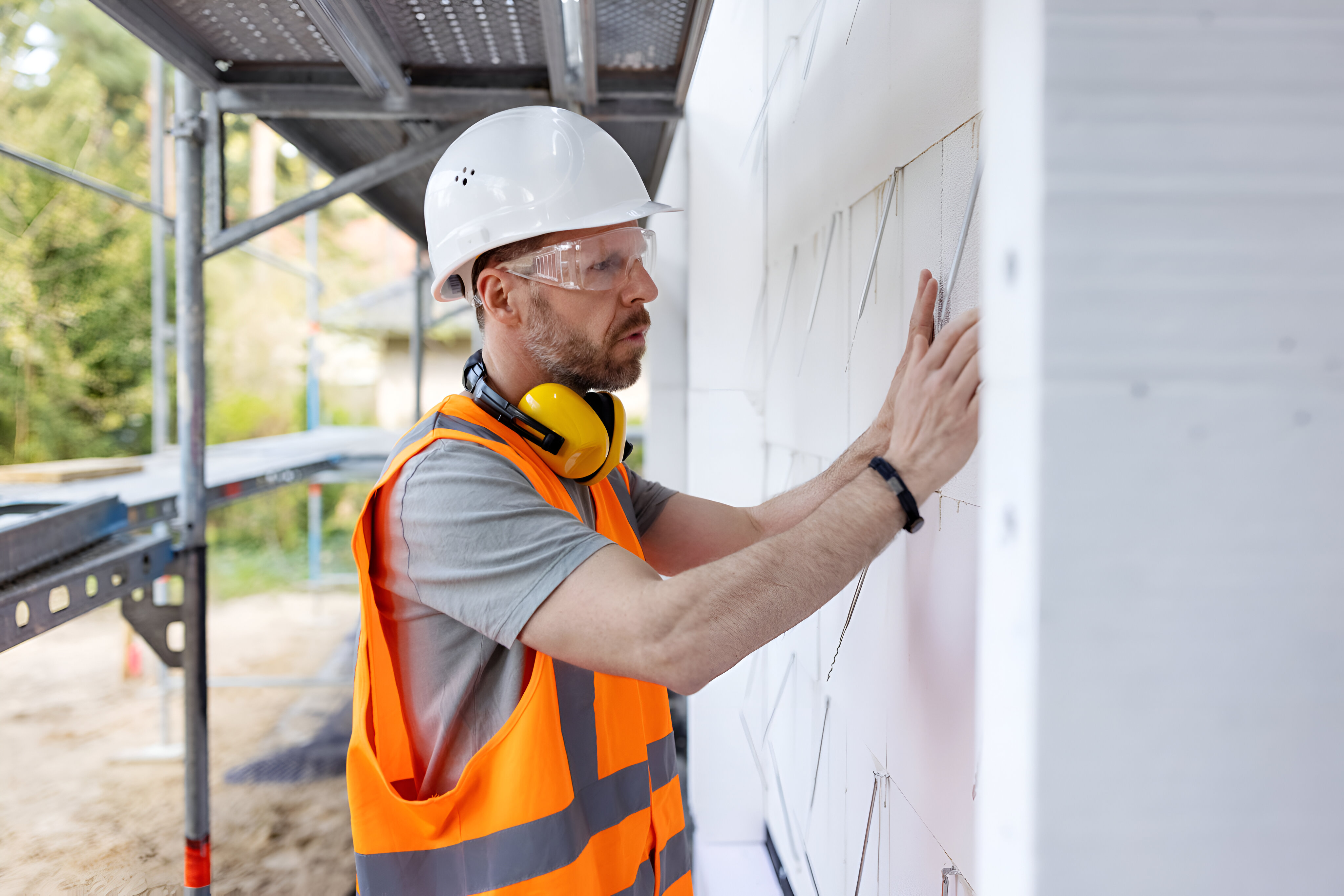
Wright Architects’ approach to energy performance is organized around envelope-first design: optimizing the thermal and moisture performance of the building shell before sizing mechanical systems. This sequence reflects a fundamental insight about how buildings perform in practice.
A building with an excellent thermal envelope requires far less mechanical capacity to maintain comfort than one with a leaky, under-insulated shell. When mechanical systems are sized for a well-performing envelope, they can be smaller, simpler, and more efficient. When sized for a poorly performing envelope, they’re larger, more expensive, and still unable to fully compensate for the building’s underlying deficiencies. The pattern of over-sized mechanical systems in under-performing buildings is one of the most persistent sources of residential energy waste.
Several members of the Wright Architects team hold PHIUS Certified Passive House Consultant and Certified Passive House Tradesperson credentials, the most rigorous available training in high-performance building envelope design and construction. The Passive House standard defines specific performance targets for envelope air tightness, thermal insulation, thermal bridge-free construction, and mechanical ventilation that, when achieved, produce buildings consuming 40 to 60 percent less energy than code-compliant equivalents.
The energy-efficient house plans the firm develops for Hudson Valley clients reflect these principles at every scale. Wall assemblies are detailed with continuous exterior rigid insulation to eliminate thermal bridging through studs. Roofs are designed with unvented assemblies and high levels of insulation that eliminate ice damming. Windows are specified with triple-pane glazing, with installation details, flashing, air sealing, threshold conditions, drawn explicitly rather than left to field judgment.
Air barrier continuity receives particular attention. Barriers are detailed at every penetration, every transition between assemblies, and every connection between the above-grade envelope and the foundation. This documentation supports blower door testing at mid-construction and at completion, the mid-construction test being especially valuable because it identifies leakage paths while they’re still accessible and remediation is cost-effective.
Buildability and the Design-Bid-Build Commitment
High-performance residential design is only as good as its construction. Wright Architects addresses the gap between design intent and construction reality through meticulous documentation, contractor relationship development, and sustained construction administration involvement.
The firm operates within the Design-Bid-Build project delivery model, a framework in which the architect completes a full set of construction documents before contractors bid, and serves as the owner’s independent representative throughout construction. This model provides the most reliable protection for design quality and owner interests, particularly for projects with high-performance requirements where details are critical.
In Design-Bid-Build, the architect’s independence from the contractor is structural. The firm reviews submittals without a financial stake in the contractor’s margin. It observes construction without interest in schedule efficiency. When a field deviation requires a decision, the architect’s judgment is guided solely by design intent and owner interests, not by the cost implications for a shared construction budget.
This independence is especially significant in high-performance construction, where the compounding of small deviations, a substituted window with a slightly higher U-value, an air barrier with different vapor permeability, an uncaught thermal bridge, can produce a building that performs significantly below its design intent. Catching these deviations requires an architect who is present, engaged, and working exclusively for the owner throughout the construction process.
The firm’s custom home design services are structured to include construction administration as an integral phase rather than an optional add-on, reflecting the conviction that the design process is not complete until the building is complete, and complete in the way it was designed.
Regional Materials and the Architecture of Belonging
One of the most distinctive characteristics of Wright Architects’ residential work is its consistent engagement with locally and regionally sourced materials, a commitment that serves both ecological and aesthetic purposes, and that connects the firm’s buildings to the long tradition of craft construction in the Hudson Valley region.
The Hudson Valley sits within a landscape that has been quarried, milled, and built with for centuries. Bluestone, quarried in Ulster and Sullivan counties, has been used in the region’s buildings since colonial times. Timber from sustainably managed Catskill forests white oak, eastern hemlock, sugar maple is available from regional sawyers and millworks. Reclaimed timber, regional brick, and lime-based plasters offer further opportunities to build with materials whose provenance and performance characteristics are deeply understood by the local construction community.
Locally sourced materials carry lower embodied carbon, having traveled shorter distances from extraction to installation. They age in ways consistent with the regional climate, developing the patinas and weathering patterns that give old Hudson Valley buildings their characteristic quality. And they connect a building to its landscape in ways that manufactured surfaces rarely match grounding the architecture in a specific place and a specific material tradition that gives it genuine regional identity.
This commitment is reflected throughout the firm’s portfolio of sustainable architecture in Kingston NY and the surrounding region, where local materials combined with high-performance construction systems have produced buildings simultaneously rooted in regional tradition and oriented toward contemporary performance standards. The two commitments to place and to performance reinforce rather than contradict each other, and their combination is one of the defining characteristics of the firm’s architectural identity.

Market Trends and the Growing Demand for Site-Responsive Design
The residential market in the Hudson Valley has evolved significantly in ways that align closely with Wright Architects’ design values. According to Hudson Valley Magazine’s coverage of regional real estate trends, the influx of buyers from New York City has brought a more sophisticated consumer base, one with higher expectations for design quality, energy performance, and environmental responsibility than previous generations of Hudson Valley homebuyers.
Nationally, demand for energy-efficient and sustainable residential construction has grown substantially, driven by rising energy costs, environmental awareness, and the demonstrated comfort benefits of high-performance buildings. Buyers are asking better questions than ever before about insulation specifications, blower door results, and the operational cost difference between a code-minimum home and a Passive House-level one. The conversation has shifted from whether energy performance matters to how much it’s worth paying for and the answer, increasingly, is: more than most people assumed.
For architects and developers in the Hudson Valley, this trend creates both opportunity and obligation. The opportunity is clear: clients who understand what high-performance design can deliver are a growing and increasingly well-informed segment of the market. The obligation is equally clear: serving that segment requires genuine expertise, credentials, process discipline, and construction rigor to produce buildings that perform as designed and can be verified rather than merely claimed efficient.
Wright Architects is positioned to meet that obligation through its combination of design expertise, Passive House credentials, regulatory knowledge, and construction quality commitment. The firm’s modern home architect Hudson Valley practice represents precisely the kind of specialized, regionally grounded expertise that the evolving market requires and that the Hudson Valley’s demanding climate and complex regulatory landscape genuinely rewards.
The Ethics of Site-Responsive Practice
There is an ethical dimension to site-responsive residential architecture that Wright Architects articulates explicitly. Every building constructed in the Hudson Valley has environmental consequences for the ecology of the land it occupies, the watershed it sits within, the carbon budget of its materials, and the energy it consumes over its operational life. A building designed carelessly will impose more burden on its occupants and its environment than one designed with full attention to these considerations and over a fifty-year operational life, the cumulative difference is substantial.
The firm’s position is that architects have an obligation to bring that full attention to every project. In a region of genuine ecological sensitivity, valued for its environmental qualities, that obligation carries particular weight. It extends to the specifics of material selection, stormwater management, site disturbance minimization, and the long-term carbon implications of construction choices, all areas where thoughtful design can meaningfully reduce a project’s environmental footprint without compromising performance or livability.
This ethical commitment also extends to transparency with clients about cost and trade-offs. The premium for Passive House-level construction typically runs 5 to 15 percent above code-compliant equivalents. The firm communicates this honestly, alongside equally honest communication about the long-term return on that investment in reduced energy costs, improved durability, and enhanced occupant wellbeing. It does not overstate performance claims or understate the discipline required to achieve them because a practice committed to honest architecture is also committed to honest client relationships.
Looking Forward: Site Responsiveness in a Changing Climate
The Hudson Valley’s climate is changing. Winters are becoming more variable, with more frequent freeze-thaw cycling. Summers are hotter and wetter, with more intense precipitation events that stress drainage systems and building envelopes in new ways. The design assumptions that governed residential construction a generation ago are increasingly inadequate for the conditions buildings will face over their operational lifetimes.
Wright Architects’ site-responsive, performance-oriented approach is well suited to this evolving context. Buildings designed with robust thermal envelopes are more resilient to temperature extremes. Buildings designed with careful attention to moisture management are better positioned to handle intense precipitation without damage. Buildings oriented for passive solar gain retain their performance advantage as energy prices and grid conditions change because the physics of solar access don’t fluctuate with utility rates or policy shifts.
The firm’s investment in Passive House credentials and high-performance expertise reflects a forward-looking commitment, a recognition that buildings designed today will face conditions their designers cannot fully anticipate, and that the most responsible response is to build to the highest available standards of durability, performance, and adaptability. Site responsiveness, in this sense, is not just about responding to the land as it exists today. It’s about building for the land as it will exist across the full lifetime of the building, a commitment to longevity and resilience that defines the best of regional architectural practice.
For architects, developers, and clients considering residential projects in the Hudson Valley and the broader Northeast, the lesson of Wright Architects’ practice is clear: site responsiveness is not a design style or a market positioning. It is a fundamental professional responsibility, the obligation to design buildings that belong to their places, perform through their conditions, and serve their inhabitants honestly across the full arc of their useful lives.
Learn more about Wright Architects’ work at wrightarchitectspllc.com.
For design inquiries, media contact, or project discussion, connect with the firm directly through their website.
Explore their full portfolio of residential architecture and sustainable design online.

 Dubb
Dubb